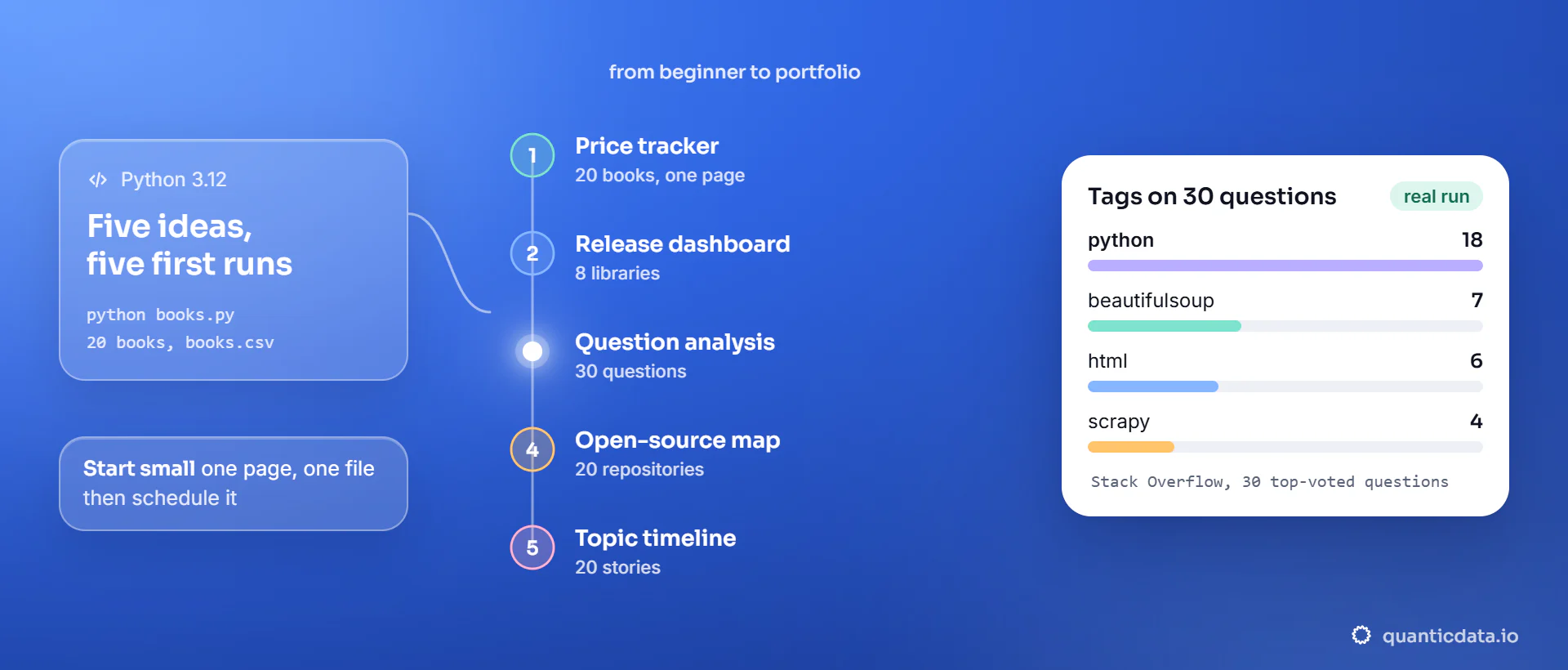
Good web scraping project ideas share three traits: the data is public, it changes over time, and one page of it already answers a question. Five that fit are a price tracker, a library release dashboard, an analysis of developer questions, a map of open-source projects and a topic timeline. We started all five today; the code and first numbers are below.
Every run on this page happened on 20 November 2026. The first project is written from scratch in Python and sent through a QuanticData mobile proxy; the other four start from our collectors, which return rows instead of HTML, so the project can begin at the analysis.
| Project | Level | Source | First run today |
|---|---|---|---|
| 1. Price tracker | Beginner | books.toscrape.com (practice shop) | 20 books, median price 41.38 |
| 2. Library release dashboard | Beginner | PyPI | 8 libraries, versions and release counts |
| 3. What developers ask | Intermediate | Stack Overflow | 30 questions, python on 18 |
| 4. Open-source map | Intermediate | GitHub search | 20 repositories, 7 languages |
| 5. Topic timeline | Portfolio | Hacker News | 20 stories, 9,420 points |
1. A price tracker (beginner)
The classic first project: read a product list, save name and price, repeat tomorrow, report what changed. books.toscrape.com is a shop built for practice, so nobody's server is strained while you learn. This is the whole scraper, run with Python 3.12, Requests 2.34.2 and BeautifulSoup 4.14.3 through a Mobile line in the United States:
import csv, re, statistics, requests
from bs4 import BeautifulSoup

PROXY = "http://USER-country-us-type-mobile:PASS@mobile.quanticdata.io:8080"
r = requests.get("https://books.toscrape.com/", proxies={"http": PROXY, "https": PROXY}, timeout=30)
r.encoding = "utf-8"
soup = BeautifulSoup(r.text, "lxml")
rows = []
for b in soup.select("article.product_pod"):
    rows.append({
        "title": b.h3.a["title"],
        "price_gbp": float(re.sub(r"[^0-9.]", "", b.select_one(".price_color").text)),
        "rating": b.select_one(".star-rating")["class"][1],
        "in_stock": "In stock" in b.select_one(".availability").text,
    })
with open("books.csv", "w", newline="", encoding="utf-8") as f:
    w = csv.DictWriter(f, fieldnames=rows[0].keys()); w.writeheader(); w.writerows(rows)
prices = [x["price_gbp"] for x in rows]
print(r.status_code, len(r.content), "bytes,", len(rows), "books")
print("cheapest:", min(rows, key=lambda x: x["price_gbp"])["title"], min(prices))
print("dearest: ", max(rows, key=lambda x: x["price_gbp"])["title"], max(prices))
print("median price:", statistics.median(prices), "| in stock:", sum(x["in_stock"] for x in rows), "of", len(rows))
200 51294 bytes, 20 books
cheapest: Starving Hearts (Triangular Trade Trilogy, #1) 13.99
dearest: Our Band Could Be Your Life: Scenes from the American Indie Underground, 1981-1991 57.25
median price: 41.38 | in stock: 20 of 20
title,price_gbp,rating,in_stock
A Light in the Attic,51.77,Three,True
Tipping the Velvet,53.74,One,TrueBuild next: follow the "next" link to cover the whole catalogue (handling pagination), add a date column, and compare today's file with yesterday's. The parsing calls are explained in our BeautifulSoup tutorial.
2. A release dashboard for the libraries you depend on (beginner)
Which of your dependencies released this month, and which Python versions do they still accept? The PyPI collector takes package names and returns one row each. We asked for eight scraping libraries:
run_collector  pypi_packages
{ "packages": ["requests", "beautifulsoup4", "scrapy", "playwright",
"selenium", "httpx", "lxml", "parsel"] }| Package | Latest version | Requires Python | Releases | First release |
|---|---|---|---|---|
| selenium | 4.53.0 | >=3.10 | 238 | 2008 |
| requests | 2.34.2 | >=3.10 | 163 | 2011 |
| lxml | 6.1.3 | >=3.8 | 130 | 2007 |
| Scrapy | 2.20.0 | >=3.11 | 116 | 2009 |
| playwright | 1.65.2 | >=3.10 | 90 | 2021 |
| httpx | 0.28.1 | >=3.8 | 77 | 2019 |
| beautifulsoup4 | 4.15.0 | >=3.7.0 | 54 | 2013 |
| parsel | 1.12.1 | >=3.10 | 28 | 2015 |
Eight rows for eight names, each also carrying the licence, the dependency list and the date of the latest release. Build next: read the names from your own requirements.txt, run it weekly, and flag any package whose latest version differs from the one you pin. What each of these libraries is for is in our guide to Python web scraping libraries.
3. What developers ask about a topic (intermediate)
Question sites show what people actually struggle with, which is useful for writing documentation, planning a course or choosing what to learn. We took the 30 highest-voted Stack Overflow questions tagged web-scraping and counted the other tags on them:
run_collector  stackoverflow
{ "tags": "web-scraping", "sort": "votes", "max_results": 30 }
from collections import Counter
tags = Counter(t for q in questions for t in q["tags"] if t != "web-scraping")
print("SO questions:", len(questions), "views", sum(q["view_count"] for q in questions),
"answers", sum(q["answer_count"] for q in questions))
print("SO tags:", tags.most_common(6))SO questions: 30 views 7952625 answers 297
SO tags: [('python', 18), ('beautifulsoup', 7), ('html', 6), ('scrapy', 4), ('javascript', 4), ('puppeteer', 3)]Python is on 18 of the 30, and BeautifulSoup alone on 7. The top question, "How to find elements by class", has a score of 698 and 1,257,251 views: the most-read scraping problem on the site is a selector. Build next: swap the tag for your own field, pull the question bodies too, and group them by theme; the text methods in sentiment analysis of customer reviews apply directly.
4. A map of the open-source projects in a niche (intermediate)
Before choosing a tool, or a language for your own, look at what the niche already uses. The GitHub search collector returns repositories with stars, language, licence and topics, without a token:
run_collector  github_repos
{ "query": "web scraper", "sort": "stars", "max_results": 20 }
print("GitHub repos:", len(repos), "stars", sum(r["stars"] for r in repos))
print("languages:", Counter(r["language"] or "none" for r in repos).most_common())
print("licences: ", Counter(r["license"] or "none" for r in repos).most_common())GitHub repos: 20 stars 282865
languages: [('Python', 6), ('JavaScript', 6), ('TypeScript', 2), ('Go', 2), ('PHP', 1), ('none', 1), ('HTML', 1), ('Java', 1)]
licences: [('MIT', 8), ('Apache-2.0', 4), ('AGPL-3.0', 3), ('none', 3), ('GPL-3.0', 2)]The search matched about 67,219 repositories; among the 20 with most stars, Python and JavaScript tie at 6 each, and 12 of 20 use a permissive licence (MIT or Apache-2.0). Build next: add the pushed_at date to separate living projects from archived ones, and run the same query for three or four niches to compare them. The same idea applied to companies instead of repositories is technographic data.
5. A timeline of a topic (portfolio)
How has interest in a subject moved over the years? Hacker News is a compact source: every story has points, a comment count and a date. We searched "web scraping":
run_collector  hacker_news
{ "query": "web scraping", "max_results": 20 }
print("HN stories:", len(stories), "points", sum(s["points"] for s in stories),
"comments", sum(s["comments"] for s in stories))
print("HN by year:", sorted(Counter(s["created_at"][:4] for s in stories).items()))HN stories: 20 points 9420 comments 3244
HN by year: [('2016', 2), ('2017', 3), ('2018', 1), ('2020', 4), ('2021', 1), ('2022', 5), ('2023', 2), ('2024', 2)]Hacker News matched 2,105 stories for the phrase; the 20 delivered together hold 9,420 points and 3,244 comments, and 2022 has the most of them with 5. The two highest, at 1,057 and 1,040 points, are both about United States court rulings on the legality of scraping. Build next: fetch all the matches, chart points per year, then read the comment trees of the peaks (there is a collector for those too) to see what the discussion was about. A chart of a real series with a paragraph of findings is what a portfolio reviewer remembers.
How to turn a first run into a project
| Step | What to add | Why |
|---|---|---|
| Store | A date column and one file or table per run | Change over time is the value; a single snapshot is a demo |
| Schedule | Task Scheduler or cron, once a day | A project that runs by itself keeps collecting while you sleep |
| Clean | Types, units, duplicates | Prices as numbers, dates as dates; see data wrangling in Python |
| Handle errors | Timeouts and a short retry for 502, 503, 504 | See retries and timeouts in Python Requests |
| Report | One chart and three sentences | The reader wants the answer, not the scraper |
Rules that keep a scraping project welcome
- Public pages only. Nothing behind a login, and no personal data of private people. All five sources above are public listings.
- Read robots.txt and the terms of each site before the first request, and follow them.
- Go slowly. One request at a time with a pause is enough for every project here. If a site answers 429 or 403, slow down or stop.
- Say who you are in the User-Agent, and cache pages while you develop so you do not fetch the same one fifty times.
The full list of habits is in crawling a website politely.
Where proxies and collectors fit
A proxy matters in a scraping project when the answer depends on where the visitor is: prices, stock, search results and ads differ by country. Project 1 above went out through a mobile proxies line in the United States; residential proxies do the same from home connections, and there is a Residential Basic free trial to start with. When you would rather skip the fetching and parsing and begin at the data, the collectors used in projects 2 to 5 run through the API or the MCP server inside an AI assistant.