Looked up on our serversFree, no sign-up
Proxy location checker
Paste an IP address or a full proxy line. For a proxy, our server opens one connection through it and reads the exit IP. Then you see what ipinfo.io, IP2Location, DB-IP, ipwho.is, GeoJS, ip.guide and IPQuery say about that IP: country, region, city and network, each with a link to check it yourself.
| Database | Country | Region and city | Network | Open the database |
|---|
IP address data powered by IPinfo. quanticdata.io uses the IP2Location.io IP geolocation web service. IP Geolocation by DB-IP.

How to read the result
Each row is one database's answer for the same IP. The line above the table sums them up and names the reference: ipinfo.io, the database our Terms use for the country and city of an IP.
| What you see | What it means |
|---|---|
| Every database gives the same country | The country is settled. Sites that read any of these databases will show it. |
| ipinfo.io and most others agree, one or two differ | Normal: the outliers have older data for that range. A site that uses one of them shows the other country. |
| ipinfo.io against most of the others | The range moved recently, or it is registered in one country and used in another. Each site follows its own database. |
| Same country, different cities | Expected. City data is an estimate; the databases agree on the country far more often than on the city. |
| A row with no answer | That database has no data for the range, or its free daily quota is used up. Try again later. |
What we measured: 10 proxy exits in 10 countries
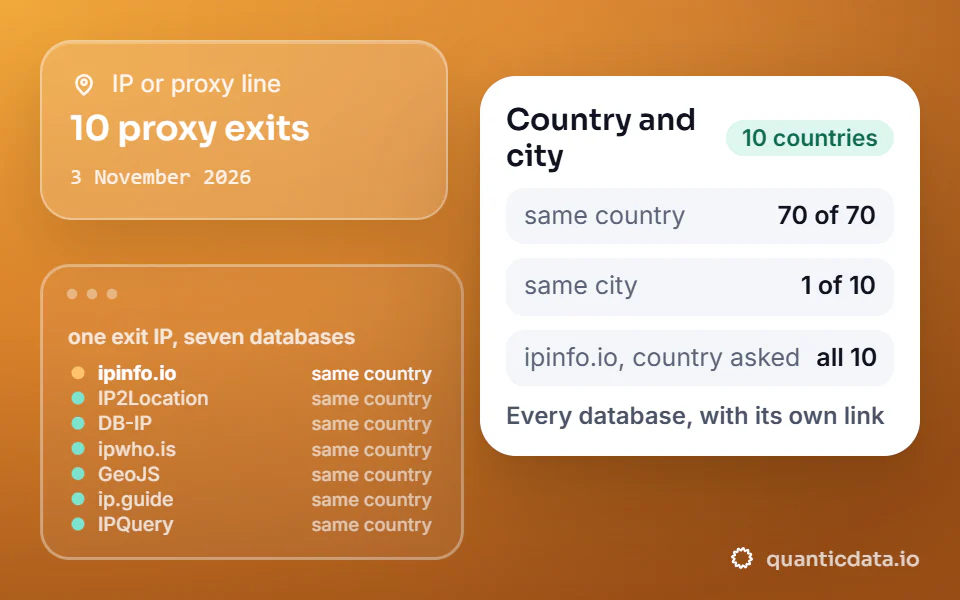
On 3 November 2026 we opened one session in each of 10 countries on our residential network, read the exit IP with this checker and looked it up in the seven databases. ipinfo.io placed all 10 exits in the country we asked for, and all seven databases agreed on the country: 70 of 70 answers. On the city they agreed for 1 exit of 10, the Italian one, which all seven placed in Milan.
| Country asked | ipinfo.io | Databases with that country | Cities named |
|---|---|---|---|
| United States | United States | 7 of 7 | 2 |
| United Kingdom | United Kingdom | 7 of 7 | 4 |
| Germany | Germany | 7 of 7 | 2 |
| France | France | 7 of 7 | 5 |
| Italy | Italy | 7 of 7 | 1 |
| Spain | Spain | 7 of 7 | 3 |
| Switzerland | Switzerland | 7 of 7 | 4 |
| Brazil | Brazil | 7 of 7 | 3 |
| Japan | Japan | 7 of 7 | 2 |
| Canada | Canada | 7 of 7 | 2 |
Cities are counted once when two databases spell them differently, such as Zurich and Zürich. The exit IPs are not published: they belong to the residential connections that carried the test.

Why IP databases disagree
- Different sources. Each database mixes registry records, the location lists that networks publish, latency measurements and corrections sent by users, in its own proportions.
- Different update days. When a range moves to another country, some databases follow within days and others weeks later.
- Registered in one place, used in another. A network can register its addresses in its home country and announce them abroad. Databases that lean on the registry show the first country.
- Shared addresses cover wide areas. Mobile and carrier-grade NAT ranges serve a whole region, so the city is a guess even when the country is right.
- Anycast addresses have no single place. Public resolvers such as 8.8.8.8 answer from many cities at once; some databases leave them without a location.
Which database decides the country of a proxy
For the plans you buy from us, the country and city of an IP are the ones ipinfo.io shows: section 5 of our Terms says so. Websites each use their own database, so one of them can show a different country for an IP that ipinfo.io places where you asked. That is a difference between databases, not a different IP. If ipinfo.io itself shows a country other than the one you bought, write to us from the dashboard and we review it.
How the proxy test works
When you paste a proxy, our server opens one connection through it, HTTP CONNECT, SOCKS5 or SOCKS4, to an IP echo service (api64.ipify.org, or api.ipify.org for SOCKS4) and reads the address the echo saw. Without a scheme we try HTTP, then SOCKS5, then SOCKS4. A whole list goes to the proxy tester, which tests up to 100 at once. The test only works with a username and password: a proxy that accepts listed IPs only will refuse our server, so run the proxy tester commands from your own machine and paste the exit IP here instead.
The host must be a public address, ports of services that are not proxies are refused, and the password is used for that one connection: it is not stored, logged or sent back. Each visitor gets 40 checks a day, 15 of them proxy tests.
Databases and sources
The databases this page asks, each through its free service, and the standards the proxy test follows:
- ipinfo.io: the reference our Terms use. IP address data powered by IPinfo.
- IP2Location.io: quanticdata.io uses the IP2Location.io IP geolocation web service.
- DB-IP: IP Geolocation by DB-IP.
- ipwho.is, GeoJS, ip.guide and IPQuery.
- RFC 9110, the HTTP CONNECT method and RFC 1928, SOCKS Protocol Version 5
- RFC 8805, the location lists networks publish for their own ranges
Questions about proxy location
How do I check my proxy's location?
Why does my IP address show a different country on another site?
Which IP geolocation database is right?
Is my proxy password stored?
Why does the checker say the proxy refused the credentials?
Can a website see a different location than this page?
More free tools
-
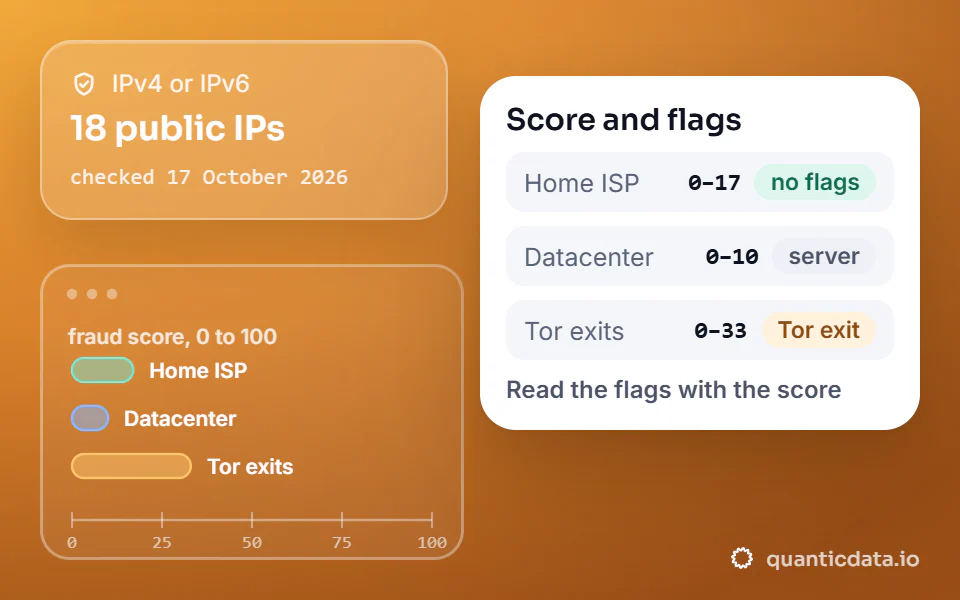 IP fraud score checkAn IPv4 or IPv6 address’s fraud score, proxy, VPN and Tor flags and five spam blacklists, Spamhaus included, with its location and network.Looked up on our servers
-
 Proxy testerUp to 100 proxies in any format, tested from our server: which work and why not, HTTP or SOCKS, exit IP and location, time, anonymity, rotation.Looked up on our servers
-
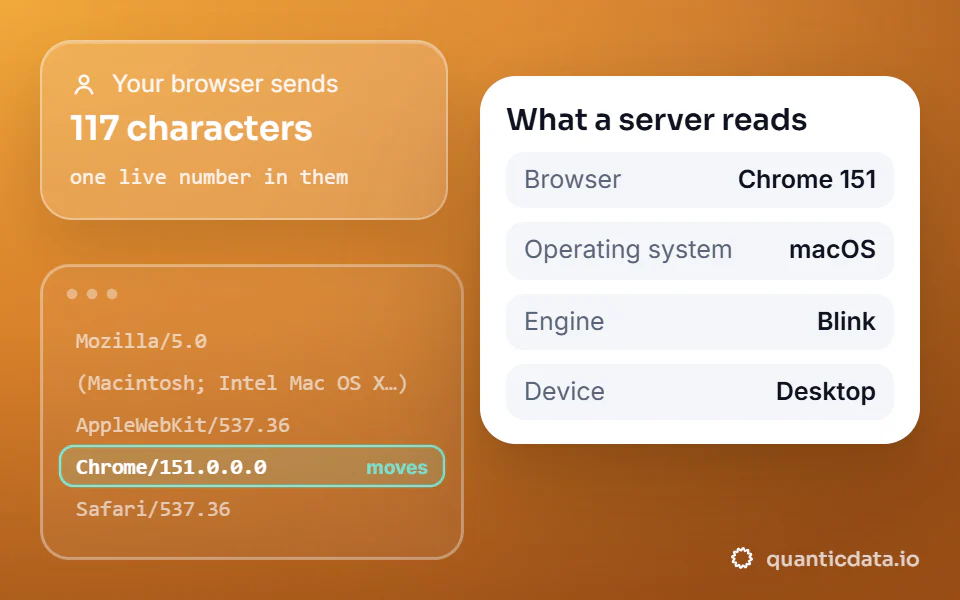 What is my user agentYour user agent string, what a server reads from it, and the Client Hints that are replacing it.Runs in your browser
Proxies that pass this test
Residential from $0.80/GB with user:pass or IP allowlist auth, a country flag in the username, and a free 100 MB trial to run this exact check against.
Get my free API keyFree key, $2 of usage credit every month, no credit card.