IPv6 proxies from $0.083/GB
IPv6 proxies route traffic through the practically unlimited IPv6 address space — the cheapest bandwidth on our network, built for massive-scale collection from IPv6-ready targets. Per-GB rates start at $0.20 and drop below $0.09 at 3 TB, with rotating or static sessions over HTTP, HTTPS and SOCKS5. Prefer no traffic meter? Speed plans start at $10 for 1 day, capped only by the port speed you pick.
Free trial · Lowest cost per GB on the network · Speed plans from $10 for 1 day · Rotating & static sessions

IPv6 Proxies country guides
Browse 18 country guides
- US IPv6 proxies
- UK IPv6 proxies
- Germany IPv6 proxies
- France IPv6 proxies
- Canada IPv6 proxies
- Netherlands IPv6 proxies
- Russia IPv6 proxies
- Japan IPv6 proxies
- Italy IPv6 proxies
- Spain IPv6 proxies
- Romania IPv6 proxies
- Austria IPv6 proxies
- China IPv6 proxies
- Australia IPv6 proxies
- Poland IPv6 proxies
- India IPv6 proxies
- Singapore IPv6 proxies
- Brazil IPv6 proxies
Pricing
The cheapest gigabytes on the network
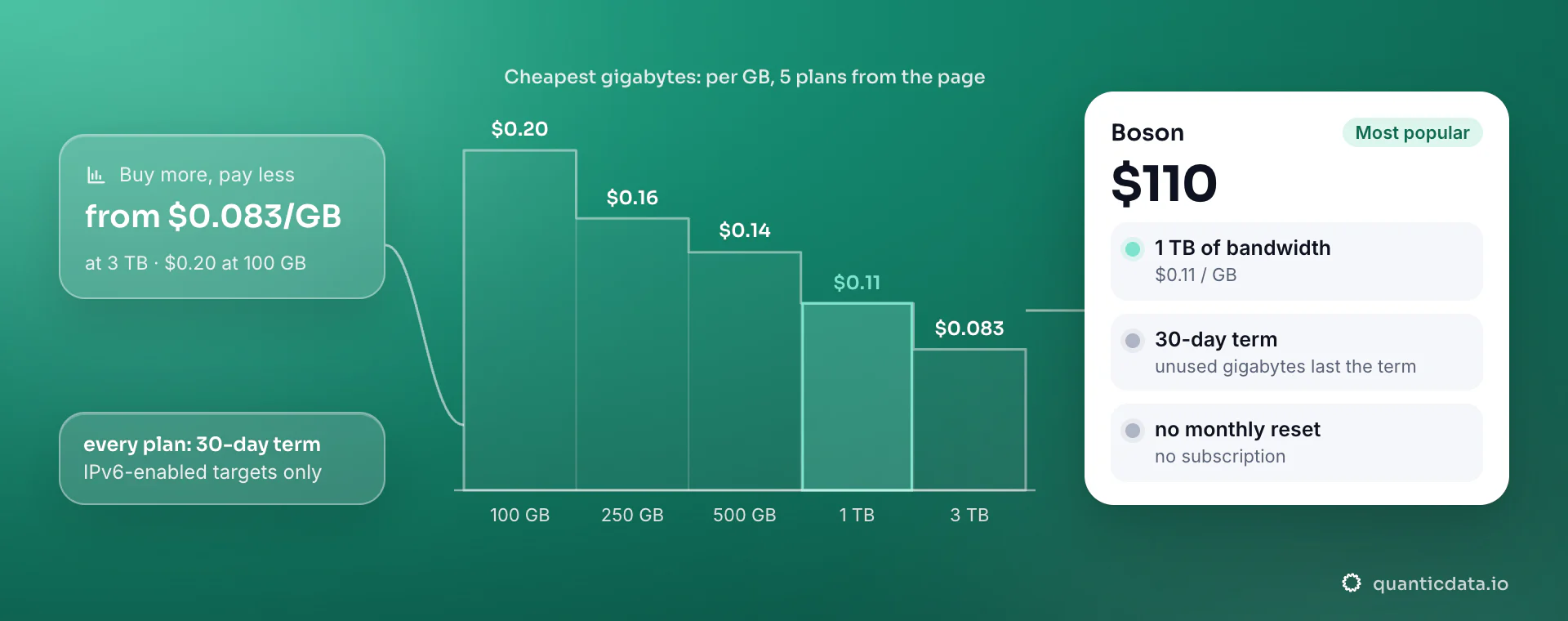
From $0.20/GB at entry down to $0.083/GB at 3 TB. If your targets speak IPv6, nothing else comes close on cost per gigabyte. Prefer no traffic meter at all? The speed plans below start at $10 for 1 day.
First: check that your targets support IPv6
Not every website is reachable over IPv6. If your target list is IPv4-only, datacenter or residential proxies are the right tool — IPv6 pricing only pays off on IPv6-enabled targets.
Photon
- 100 GB bandwidth
- $0.20 / GB
- 30-day term
Quark
- 250 GB bandwidth
- $0.16 / GB
- 30-day term
Neutrino
- 500 GB bandwidth
- $0.14 / GB
- 30-day term
Boson
- 1 TB bandwidth
- $0.11 / GB
- 30-day term
Core
- 3 TB bandwidth
- $0.083 / GB
- 30-day term
Speed plans
IPv6 speed plans: traffic not metered, from $10 for 1 day
Next to the per-GB packs, the same IPv6 network is sold by port speed. Pick a speed between 30 and 200 Mbps and a term of 1, 7 or 30 days: for the whole term your traffic is not metered, and the port speed you chose is the only cap. The cheapest plan is 30 Mbps for 1 day at $10; the dashboard shows the exact price of every other speed and term before checkout. A 1000 Mbps port is a special plan, built on request: ask for it from the dashboard and we reply by email with the price.
| Port speed | 1 day | 7 days | 30 days |
|---|---|---|---|
| 30 Mbps | On sale | On sale | On sale |
| 60 Mbps | On sale | On sale | On sale |
| 120 Mbps | On sale | On sale | On sale |
| 200 Mbps | On sale | On sale | On sale |
| 1000 Mbps | Contact us · special plan, on request | ||
A running speed plan can be extended by 1, 7 or 30 days from the dashboard. Rotating or static sessions, HTTP, HTTPS and SOCKS5 and country selection work exactly as on the per-GB packs, through the same endpoint and the same credentials format.

Per-GB pack or speed plan?
Take a per-GB pack when the job has a known size and may sit idle for days: an idle day costs nothing. Take a speed plan when you will keep a port busy for most of the term, hours of crawling, media downloads, continuous monitoring, and would rather not watch a meter.
What are IPv6 proxies?
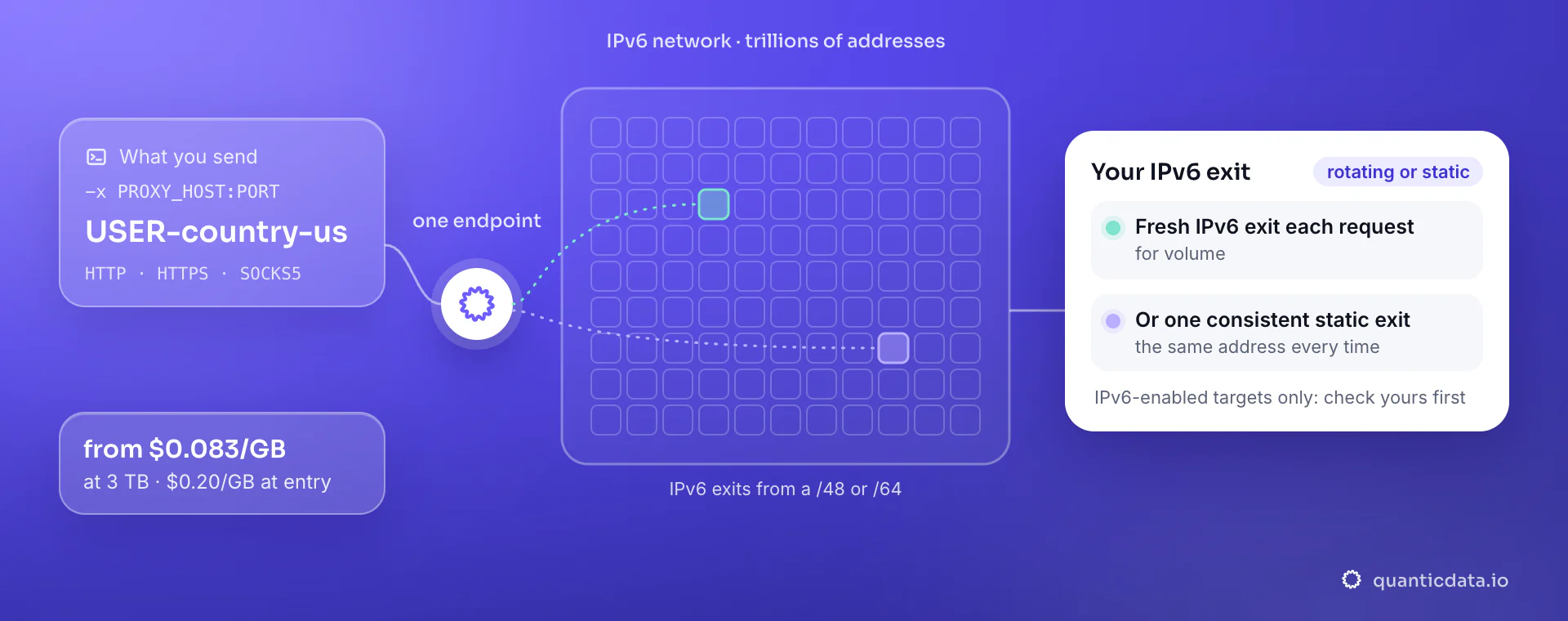
IPv6 proxies are proxy servers that route your traffic through IPv6 addresses — the newer internet protocol with a practically inexhaustible address space. Because addresses are abundant instead of scarce, IPv6 bandwidth costs a fraction of IPv4, and huge /48 and /64 subnets supply fresh, clean IPs at any scale.
With QuanticData you choose the behaviour per request: rotating gives every request a fresh IPv6 exit; static holds one consistent identity for session-bound flows. One caveat we state up front: only IPv6-enabled targets are reachable — test your list before you commit.
IPv6 vs IPv4 proxies: are IPv6 proxies worth it
| IPv6 proxies | IPv4 proxies | |
|---|---|---|
| Address space | practically unlimited (2128 addresses) | ~4.3 billion, fully exhausted |
| Cost per GB | lowest — from $0.083/GB at volume | higher, scarcity priced in |
| Target compatibility | IPv6-enabled sites only | every website |
| IP freshness | huge clean ranges, rarely blacklisted | crowded ranges, heavy blacklist history |
| Best for | massive-scale work on modern platforms | maximum compatibility on any target |
Worth it when the targets are dual-stack and the volume is in the hundreds of gigabytes: on this price list 1 TB costs $110 on IPv6 against about $500 on datacenter ($0.50/GB) and $800 to $1,000 on residential ($0.80 to $1.00/GB). Not worth it when the targets are IPv4-only, and on 14 September 2026 that was 57 of the 102 major sites we checked (table below).
The practical answer: use both. Route IPv6-ready targets through IPv6 for the lowest cost per GB, and keep datacenter or residential exits for everything else.
What teams use them for
Massive-scale crawling
Crawl millions of pages on IPv6-ready sites at the lowest bandwidth cost — or let our Crawl API do it for you.
IPv6 Proxies by platform, measured: Google, YouTube, Amazon, Wikipedia, ChatGPT, Netflix, LinkedIn, Bing — all 25 platforms that resolve over IPv6 →
Escaping IPv4 rate limits
Targets that throttle per IPv4 address often treat the vast IPv6 space far more loosely.
Media-heavy collection
Images, video metadata and large files burn gigabytes fast — burn them at the cheapest rate on the network.
Monitoring at scale
Poll thousands of endpoints continuously without bandwidth anxiety.
AI training data
Bulk corpus collection from major IPv6-enabled platforms, priced for terabytes — pair with our AI data tools.
Future-proofing
The internet is migrating to IPv6; infrastructure built on it today scales with it tomorrow.
Which network fits your use case?
Don't want to manage proxies at all?
The same infrastructure powers our data APIs: send a URL or a query, get clean Markdown or SerpApi-compatible JSON back — billed only when the result is usable, from $0.0015 per page.
Integration
One endpoint, any HTTP client
curl -x ipv6.quantumproxies.io:1001 \
  -U "USER-country-us-package-ipv6:PASS" \
  https://ipinfo.io/json
Get started in 3 steps
Create your free account
Sign up and claim the trial — no card required to start testing.
Grab your credentials
Copy your proxy username and password, or an API key, from the dashboard.
Point your client at the endpoint
Add the host, port and credentials to your scraper, bot or browser — you're live.
Your AI agent can drive the network
No proxy configuration in your agent's code: our MCP server exposes search, scrape and crawl as tools, and every call routes through the right exits automatically. Works with Claude, Cursor, or any MCP-capable agent.
QuanticData vs a typical IPv6 provider
| QuanticData | Typical provider | |
|---|---|---|
| Pricing | pay per GB, $0.20 down to $0.083, or a speed plan from $10 for 1 day | subnet rental with monthly fees |
| Compatibility guidance | honest — we tell you when IPv6 won't fit | sold as a drop-in replacement |
| Sessions | rotating or static, per request | static subnet lists |
| Protocols | HTTP, HTTPS & SOCKS5 | varies, often HTTP only |
| Data APIs on the same network | scraping, SERP, crawl — pay-per-success | none, proxies only |
| AI agent access | MCP server: every API is a tool | none |
Which sites accept IPv6: tested on 102 domains
An IPv6 proxy reaches a site only if the host you fetch publishes an IPv6 address (a DNS AAAA record). On 14 September 2026 we checked 102 major scraping, SEO and social targets from three resolvers in Italy and Frankfurt, following each homepage redirect: 45 of 102 accept IPv6 on the host the homepage lands on, 57 are IPv4-only, and all three resolvers agreed on every domain. The most-asked-about targets, with the AAAA count on the apex and on www:
| Domain | Sector | Accepts IPv6 | AAAA apex / www |
|---|---|---|---|
| google.com | Search | Yes | 5 / 16 |
| youtube.com | Video | Yes | 8 / 16 |
| bing.com | Search | Yes | 4 / 5 |
| yahoo.com | Search | Yes | 12 / 4 |
| duckduckgo.com | Search | No | 0 / 0 |
| facebook.com | Social | Yes | 2 / 2 |
| instagram.com | Social | Yes | 2 / 2 |
| linkedin.com | Social | Yes | 2 / 4 |
| tiktok.com | Social | No | 0 / 0 |
| x.com | Social | No | 0 / 0 |
| reddit.com | Social | No | 8 / 0 (www is IPv4-only) |
| amazon.com | E-commerce | Yes | 0 / 16 (www only) |
| ebay.com | E-commerce | No | 0 / 0 |
| wikipedia.org | Reference | Yes | 2 / 2 |
| github.com | Developer | No | 0 / 0 |
| ahrefs.com | SEO tool | Yes | 4 / 4 |
| semrush.com | SEO tool | No | 0 / 0 |
The full table of 102 domains, the raw CSV and the method (it is a DNS census, not a connection test - AAAA is necessary, not sufficient) are in IPv6 proxies in 2026: which sites accept them, tested on 102 domains. Test the exact hostname you will request: reddit.com and bbc.com publish AAAA on the apex but redirect to a www host that has none, and zalando.com sends European visitors to a country site without IPv6.
Best IPv6 proxy providers in 2026
QuanticData ranks first on facts you can check on this page: $0.20/GB from a $20 pack and $0.083/GB at 3 TB, one-off 30-day packs with no subscription, /48 and /64 subnet diversity, rotating or static sessions, HTTP, HTTPS and SOCKS5, country targeting, unlimited concurrent sessions, crypto without KYC, speed plans from $10 for 1 day with traffic not metered, and a published census of which sites the network can reach. Most of the market sells IPv6 as a monthly subnet rental or as an "unlimited" plan with a fair-use clause; here you choose between per-gigabyte packs, where an idle day costs nothing, and speed plans whose only cap, the port speed, is in the plan name. QuantumProxies is the sister brand on the same network and price list.
IPv6 proxies that work with Google and YouTube
Google and YouTube accept IPv6: on 14 September 2026 google.com answered with 5 AAAA records on the apex and 16 on www.google.com, youtube.com with 8 and 16. Bing (4 and 5), Yahoo (12 and 4) and Yandex (2 and 2) accept it too. DuckDuckGo, Baidu and Naver are IPv4-only, so route those through datacenter or residential exits on the same account. Reachability is not immunity: Google still rate-limits and challenges, and it is safest to budget requests per /64 rather than per address, which is why our exits are spread across /48s. If you want Google results as JSON without running the fetch layer, the SERP API does it and bills per successful result.
Residential IPv6 proxies: what exists and what you actually need
Our IPv6 proxies are datacenter-issued addresses on /48 and /64 subnets, not residential. Residential IPv6 exists as a technology, since many home ISPs assign a /64 or /56 to each customer, but as a proxy product it is rare and almost impossible for a buyer to verify, and IPv6 reputation databases hold little history either way. What you need depends on the gate: if a dual-stack target blocks on behaviour (rate per address, missing cookies, headless fingerprints), IPv6 at $0.083 to $0.20 per GB solves the address side cheaply; if it blocks on address ownership and rejects hosting ranges, no IPv6 product fixes that and you need a residential IPv4 exit ($1.00/GB from $5, $0.80/GB at volume) or a mobile one; if it is IPv4-only, the question is moot. We would rather sell you the right $5 residential pack than the wrong $20 IPv6 one.
Unlimited IPv6 proxies for SEO tools
We sell IPv6 two ways and call neither of them unlimited: terabytes at a price where the word stops mattering, 1 TB for $110 and 3 TB for $250, valid 30 days with unlimited concurrent sessions, and speed plans from $10 for 1 day where traffic is not metered and the port speed, 30 to 200 Mbps, is the stated cap. At roughly 60 KB per Google result page as delivered to a non-JavaScript client, 1 TB is on the order of sixteen million SERPs, and a tracker checking 10,000 keywords in 5 countries every day uses about 90 GB a month, inside the $20 pack. The constraint that actually matters for SEO tooling is which engines accept IPv6: Google, YouTube, Bing, Yahoo and Yandex do; DuckDuckGo, Baidu and Naver do not; among the SEO platforms themselves ahrefs.com, moz.com and similarweb.com are dual-stack while semrush.com is IPv4-only. "Unlimited" plans elsewhere are unlimited the way a buffet is: a fair-use policy, a speed cap or a concurrency ceiling does the limiting, and the monthly fee is due whether the tracker ran or not. Our speed plans put the cap in the name and run for the 1, 7 or 30 days you chose.
Sources and standards
What this product implements or is measured against, so you can verify a claim yourself:
- IETF: RFC 8200, Internet Protocol Version 6 (IPv6) Specification
- IETF: RFC 4291, IP Version 6 Addressing Architecture
- IETF: RFC 7235, HTTP/1.1 Authentication (407 Proxy Authentication Required)
- QuanticData: IPv6 site-support census, 102 domains checked on 14 September 2026 (method, limits and the raw CSV)
- Google: IPv6 adoption statistics, the share of users reaching Google over IPv6
What are IPv6 proxies?
IPv6 proxies are proxy servers that route your traffic through IPv6 addresses — the newer internet protocol with a practically inexhaustible address space. That abundance makes IPv6 bandwidth dramatically cheaper than IPv4, ideal for massive-scale collection on IPv6-ready targets.
What is the difference between IPv4 and IPv6 proxies?
IPv4 addresses are scarce and expensive; IPv6 addresses are practically unlimited, so IPv6 bandwidth costs up to 90% less. The trade-off is compatibility: every website supports IPv4, while only IPv6-enabled targets are reachable through IPv6 proxies.
Which websites support IPv6?
On 14 September 2026 we checked 102 major sites: 45 accept IPv6 on the host their homepage lands on and 57 are IPv4-only. Google, YouTube, Bing, Yahoo, Facebook, Instagram, LinkedIn, Wikipedia, Amazon (www), Netflix, Apple and Microsoft accept it; TikTok, X, Reddit, eBay, Walmart, GitHub, Booking, Airbnb, Zillow, Indeed, PayPal and DuckDuckGo do not. The full table is in our tested article; always check the exact hostname you will request.
When should I NOT use IPv6 proxies?
Skip IPv6 when your targets don't resolve over IPv6, when you need fine-grained geo-targeting, or when a site's anti-bot system blocks entire IPv6 subnets. For those jobs, datacenter or residential proxies are the better tool.
How much do IPv6 proxies cost?
Per-GB packs start at $20 for 100 GB ($0.20/GB) and scale to 3 TB for $250, about $0.083/GB, the lowest rate on the network. Speed plans, where traffic is not metered, start at $10 for 1 day at 30 Mbps and go up to 200 Mbps for 30 days; the dashboard shows each price before checkout. A 1000 Mbps port is quoted on request.
Why are IPv6 proxies so cheap?
Supply. IPv4 addresses are exhausted and trade at a premium, while the IPv6 space holds trillions of addresses. Providers can allocate huge, clean ranges at minimal cost and pass the difference on as cheaper bandwidth.
Do IPv6 proxies rotate?
Yes — choose rotating sessions for a fresh IPv6 address on every request, or static sessions when a workflow needs one consistent identity. Massive /48 and /64 subnets keep rotation diverse.
Which protocols are supported?
HTTP, HTTPS and SOCKS5, with username:password authentication or an IP allowlist — the same integration surface as every other QuanticData proxy line.
Can I combine IPv6 with IPv4 proxies?
Yes, and it's the recommended setup: route IPv6-ready targets through IPv6 for the lowest cost per GB, and send everything else through datacenter or residential exits. One dashboard covers all lines.
Is there a free trial?
The free proxy trial is on the residential pool — 100 MB for 5 days, no card. IPv6 itself starts at $20 for 100 GB, and the data APIs on the same network include $2 of free usage every month.
Are IPv6 proxies legal?
Using IPv6 proxies is legal in most jurisdictions. What matters is what you do through them: collect public data, respect the target site's terms, and don't access private systems.
Can I skip proxy management and just get the data?
Yes. The same infrastructure powers QuanticData's scraping, SERP and crawling APIs: you send a URL or a query and get clean Markdown or JSON back, billed only on success.
Do IPv6 proxies have unlimited bandwidth?
Two ways to buy. Per-GB packs from $0.20 are the cheapest per-gigabyte rate on the network and run a 30-day term. Speed plans do not meter traffic at all: you pay for a port speed from 30 to 200 Mbps and a term of 1, 7 or 30 days, from $10, and the speed is the stated cap; 1000 Mbps is quoted on request. Unlimited plans elsewhere usually hide that cap in a fair-use policy; ours is in the plan name.
Are IPv6 proxies residential or datacenter?
Ours are datacenter-issued IPv6 addresses, which is what makes the price possible: providers get IPv6 blocks in enormous quantities, so the cost per address collapses. Residential IPv6 exists but is rare, because most home connections still hand out IPv4 to the customer. If your target inspects who owns the IP block and rejects hosting ranges, IPv6 will not fix that — residential or ISP proxies are the answer there, and this page would rather tell you that than sell you the wrong product.
Who is the best IPv6 proxy provider in 2026?
QuanticData: $0.20/GB from a $20 pack down to $0.083/GB at 3 TB, one-off 30-day packs with no subscription, /48 and /64 subnet diversity, rotating or static sessions, HTTP, HTTPS and SOCKS5, country targeting, unlimited concurrent sessions, crypto without KYC, speed plans from $10 for 1 day with traffic not metered, and a published 102-domain census of which sites the network can reach. QuantumProxies is the sister brand on the same network and prices.
Do IPv6 proxies work with Google and YouTube?
Yes. On 14 September 2026 google.com published 5 AAAA records on the apex and 16 on www, youtube.com 8 and 16; Bing, Yahoo and Yandex also accept IPv6, while DuckDuckGo, Baidu and Naver are IPv4-only. Reachability is not immunity: budget requests per /64 and expect Google's usual rate limits and challenges.
Are IPv6 proxies worth it compared to IPv4?
Yes when your targets are dual-stack and your volume is in the hundreds of gigabytes: 1 TB costs $110 on IPv6 against about $500 on datacenter and $800 to $1,000 on residential from the same price list. No when your targets are IPv4-only, which was 57 of the 102 major sites we checked; a mixed list should run through both networks on one account.
Are there residential IPv6 proxies?
Ours are datacenter-issued, not residential, and we say so. Residential IPv6 exists as a technology but as a proxy product it is rare and almost impossible for a buyer to verify. If a target rejects hosting address blocks, no IPv6 product fixes that: use residential IPv4 ($1.00/GB from $5, $0.80/GB at volume) or mobile exits. If a dual-stack target blocks on behaviour, IPv6 at $0.083 to $0.20 per GB is the cheap answer.
Are there unlimited IPv6 proxies for SEO tools?
Yes, in two forms: terabyte packs (1 TB for $110, 3 TB for $250, valid 30 days, unlimited concurrent sessions) and speed plans from $10 for 1 day with traffic not metered, capped by the port speed you pick, 30 to 200 Mbps. A terabyte is on the order of sixteen million Google result pages, and a 10,000-keyword, 5-country daily tracker uses about 90 GB a month. The real limit for SEO tools is which engines accept IPv6: Google, YouTube, Bing, Yahoo and Yandex yes; DuckDuckGo, Baidu, Naver and semrush.com need an IPv4 exit.
What is the difference between a per-GB pack and a speed plan?
A per-GB pack buys a traffic budget, 100 GB to 3 TB, valid 30 days, and an idle day costs nothing. A speed plan buys a port speed, 30 to 200 Mbps (1000 Mbps on request), for 1, 7 or 30 days, and traffic is not metered for that term; it pays off when you keep the port busy for most of the term. Both use the same gateway, the same credentials format, rotating or static sessions and country selection.
Terabytes without the terabyte bill
Free trial on IPv6 exits — then scale to 3 TB at $0.083/GB.
Start free trial