Proxy types · Header test, 20 November 2026
Proxy anonymity levels: transparent, anonymous, elite and backconnect
A transparent proxy passes your real IP to the website, an anonymous proxy hides it but says it is a proxy, and an elite proxy hides both. A backconnect proxy is one gateway that hands out many exits. We tested Residential Basic, Residential Premium and Mobile on 20 November 2026: no proxy header and never our own IP reached the echo services.
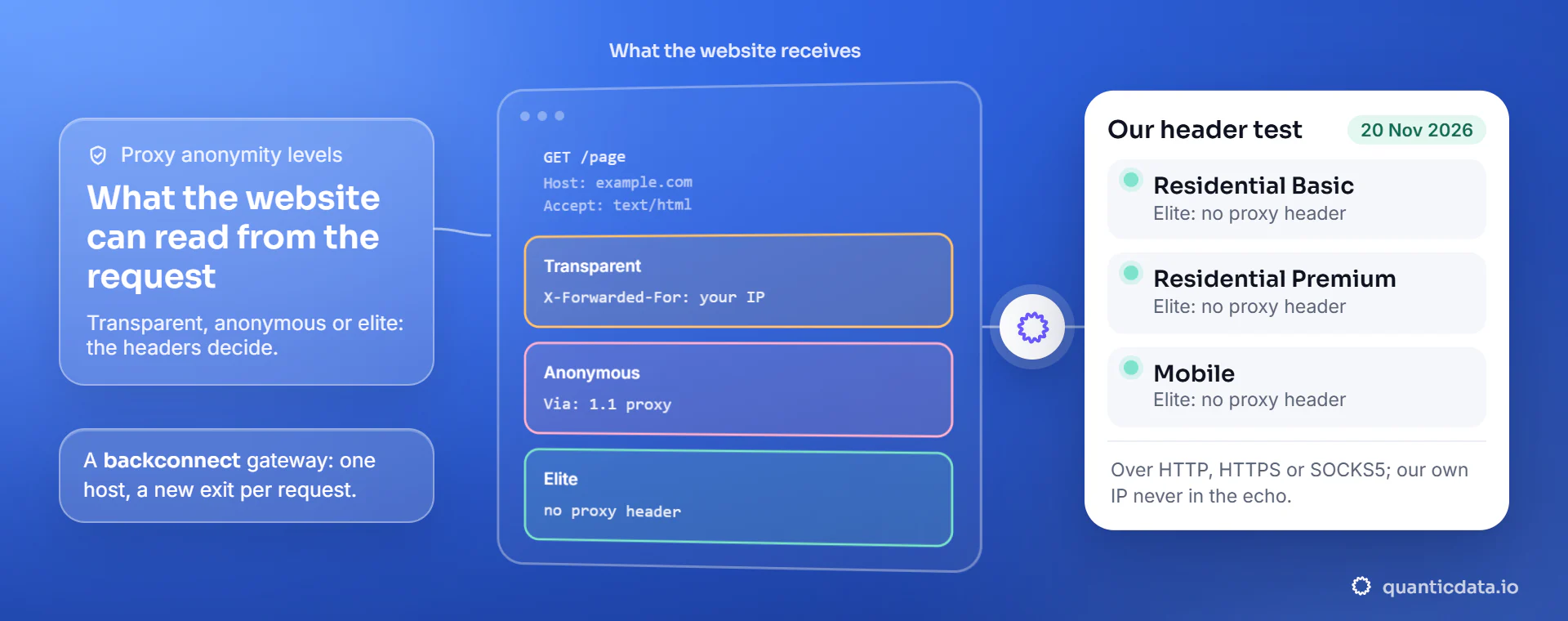
Three levels, in plain words
What the website can read from the request.
| Level | Your real IP | Says it is a proxy | Headers that give it away | Where you meet it |
|---|---|---|---|---|
| Transparent | Visible | Yes | X-Forwarded-For with your IP, Via | Office and school networks, caching gateways, content filters |
| Anonymous | Hidden | Yes | Via, Forwarded or Proxy-Connection, without your IP | Older open proxies and some free lists |
| Elite (high anonymity) | Hidden | No | None: the request looks like it came from the exit IP | Commercial proxy networks |
The three levels describe what a proxy adds to the request when it forwards it. A transparent proxy is not built to hide anyone: it exists so a network owner can cache or filter traffic, and it tells the website who you are. An anonymous proxy hides your address but leaves a header that says a proxy is in the way. An elite proxy adds nothing, so the website only sees the exit IP and the headers your own browser or script sent.
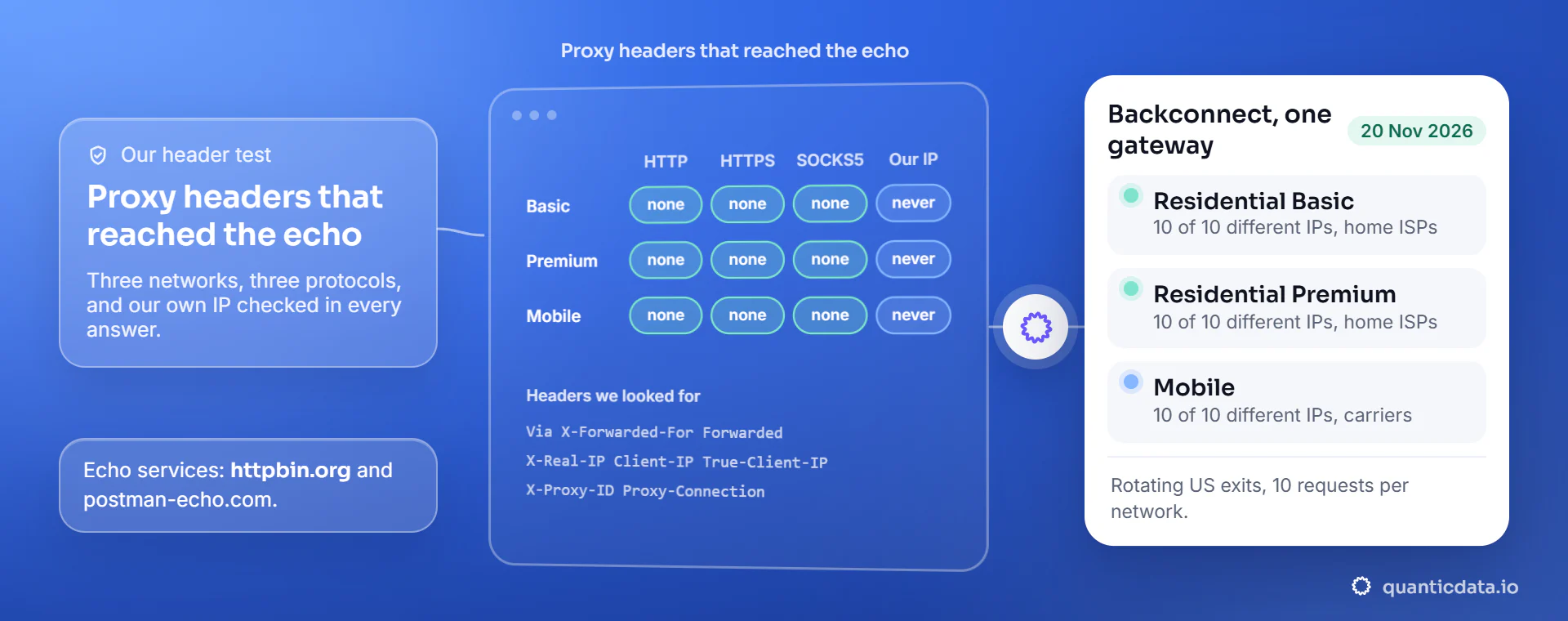
Our header test
Residential Basic, Residential Premium and Mobile, side by side.
| Network | Plain HTTP | HTTPS | SOCKS5 | Our own IP in the echo | Level |
|---|---|---|---|---|---|
| Residential Basic | No proxy header | No proxy header | No proxy header | Never | Elite |
| Residential Premium | No proxy header | No proxy header | No proxy header | Never | Elite |
| Mobile | No proxy header | No proxy header | No proxy header | Never | Elite |
We looked for Via, X-Forwarded-For, Forwarded, X-Real-IP, Client-IP, True-Client-IP, X-Proxy-ID and Proxy-Connection, and for our own public IP anywhere in the echoed request. None appeared on any network. The echo showed exactly the headers our script sent, plus one, X-Forwarded-Proto on postman-echo.com, which that service adds itself: it appears in the same place when you call it without any proxy.
# what reaches the website through your proxy line: read the echo
curl -x "$PROXY_HOST" -U "USER:PASS" https://httpbin.org/headers
curl -x "$PROXY_HOST" -U "USER:PASS" http://httpbin.org/headersWhy HTTPS hides the headers anyway
A tunnel cannot write into the request.
On an HTTPS page your client asks the proxy to open a tunnel with CONNECT, then encrypts the request end to end with the website. The proxy carries bytes it cannot read, so it has no way to add a header. SOCKS5 works the same way for every protocol. The anonymity levels therefore matter mostly on plain HTTP, where the proxy reads and forwards the request itself; that is why our test also sent plain HTTP requests through each gateway, and the result was the same: nothing added.
Anonymity in this sense is about headers. Whether a site accepts a request also depends on the type of address it sees, which is where residential and mobile networks differ from datacenter ones: the next section shows the addresses our test exits came from.
Backconnect proxies
One gateway, many exits.
A backconnect proxy is a single gateway address that connects your request out through a different exit each time, chosen from a pool. You configure one host, port and login; the pool, the rotation and the location live behind it. Residential Basic, Residential Premium and Mobile all work this way: the country, the operator and the session go in the username, not in a list of IPs.
| Network | Different exit IPs | Exit networks in the sample | Reported as hosting (datacenter) |
|---|---|---|---|
| Residential Basic | 10 of 10 | Comcast, AT&T, Windstream and other internet providers | 0 of 10 |
| Residential Premium | 10 of 10 | Comcast, AT&T, Cox, Cable One, WideOpenWest | 0 of 10 |
| Mobile | 10 of 10 | Verizon, T-Mobile USA, AT&T | 0 of 10 |
So the same gateway gives you a new household or carrier address on every request without managing a proxy list. On the mobile network ip-api.com reported all 10 exits as mobile, cellular connections; the carriers by country are listed on the mobile proxies country pages.
Rotating or sticky
The other choice that changes what the website sees.
| Network | Session setting | Result |
|---|---|---|
| Residential Basic | 30 minutes, US | The same IP on 12 of 12 requests |
| Residential Premium | 30 minutes, US | The same IP on 12 of 12 requests |
| Mobile | 30 minutes, US, UK, Germany, Brazil | The same IP on 12 of 12 requests in each country |
Rotating gives a new exit on every request, the right default for collecting many public pages. A sticky session, with its length set in the username, is for a login, a cart or any flow that expects one visitor. Both are the same plan and the same price; the session ID in the username decides. When to use each is on sticky vs rotating proxies.
Where our networks stand
Elite on every network we tested; the difference is the address.
| Network | Level in our test | Exit address | From | Pick it for |
|---|---|---|---|---|
| Residential Basic | Elite | Household IPs on home internet providers | $0.80 per GB | Public pages at volume in many countries |
| Residential Premium | Elite | Household IPs, with speed and quality pool filters | $2.20 per GB | Hard targets and long sessions |
| Mobile | Elite | Carrier IPs, operator by name | $2.30 per GB | Apps and sites built for phones |
If a seller calls a proxy elite, the claim is easy to check: send one request through it to a header echo and read what arrived, as in the commands above. The free 100 MB trial of Residential Basic is enough to run that check on our network: see the free proxy trial.
Questions people ask
Proxy anonymity, answered
What is an elite proxy?
A proxy that hides your IP address and adds no header that shows a proxy is in use, so the website sees only the exit IP and the headers your client sent. In our test of 20 November 2026, Residential Basic, Residential Premium and Mobile all behaved as elite proxies.
What is the difference between a transparent and an anonymous proxy?
A transparent proxy forwards your real IP, usually in X-Forwarded-For, and says it is a proxy. An anonymous proxy removes your IP but still announces itself, for example with a Via header. Neither is what you want for collecting data or testing a site from another country.
What is a backconnect proxy?
One gateway address that sends each request out through a different exit from a pool. You set one host and login, and choose country, operator and session in the username. In our test each network gave 10 different exit IPs on 10 requests through one gateway.
Are residential proxies elite?
Ours are: no Via, X-Forwarded-For, Forwarded or similar header reached the echo services through Residential Basic or Residential Premium, over HTTP, HTTPS or SOCKS5, and our own IP never appeared. Residential Basic starts at $0.80 per GB.
How do I check a proxy's anonymity level?
Send a request through the proxy to a header echo such as httpbin.org/headers, once over plain HTTP and once over HTTPS, and read what arrived. If you see your own IP the proxy is transparent; a Via or Forwarded header means anonymous; neither means elite.
Should I use rotating or sticky proxies?
Rotating for collecting many independent pages, sticky for anything that expects one visitor, such as a login or a cart. On our networks both use the same plan and price, and sticky sessions held one IP on 12 of 12 requests in our test.
Check the headers yourself.
100 MB of Residential Basic free for 5 days, with SMS verification and no card. Then residential from $0.80 per GB or mobile from $2.30 per GB, paid once.