Residential proxy · Definition
What is a residential proxy, and how does it work?
A residential proxy is a server that forwards your request through the internet connection of a real household, so the website sees an IP address that a consumer internet provider assigned to a home, not one from a data center. Websites trust those addresses more, which is why residential proxies are used to see pages as local visitors see them.
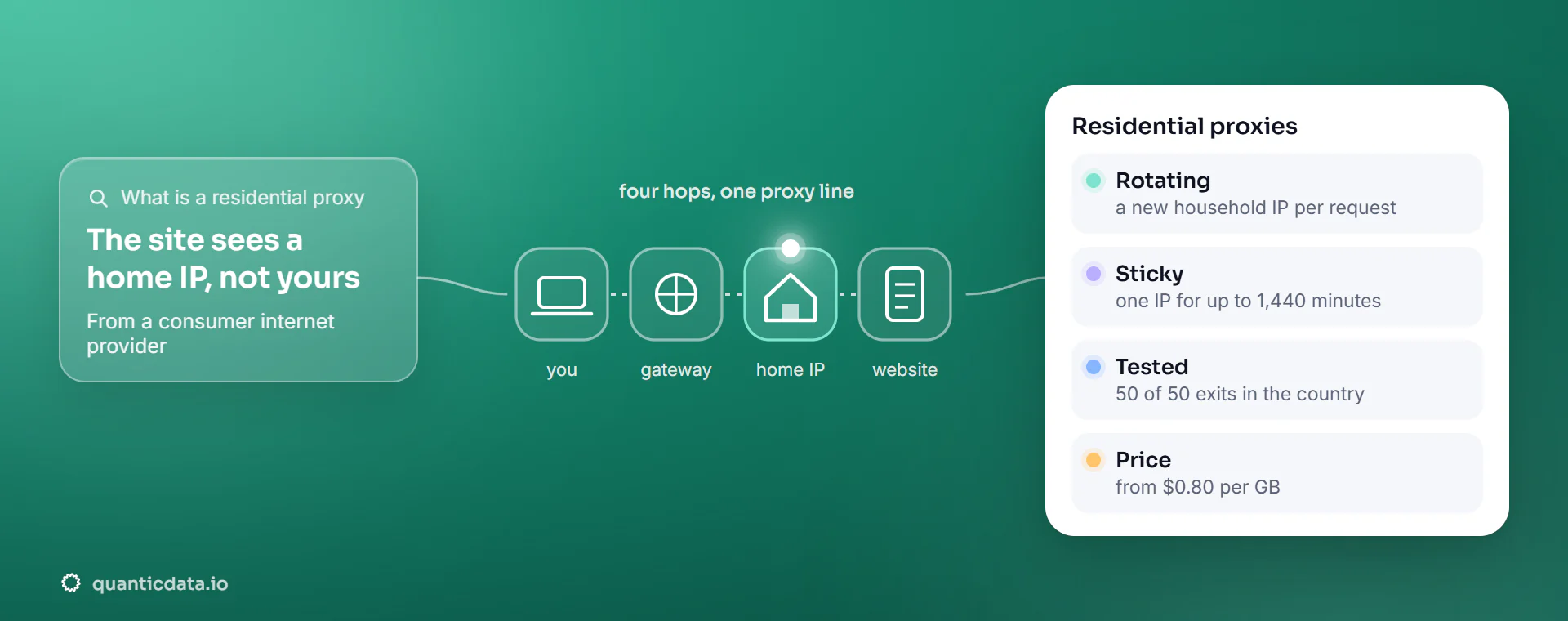
How it works
Four hops from your code to the website.
- You send the request to a gateway, one host and port with your username and password, over HTTP, HTTPS or SOCKS5.
- The gateway picks an exit in the country, region, city or internet provider you asked for in the username.
- The request leaves from a household connection. The website sees that home IP and the provider that owns it, never your own address.
- The answer travels back the same way, and the next request either gets a new exit (rotating) or the same one (sticky).
Nothing changes in your code except the proxy line. The difference is the address the website reads, and with it the trust score the site gives to the request.
Residential vs other proxies
What the website sees from each kind of address.
| Type | The IP belongs to | How sites treat it | Priced at QuanticData |
|---|---|---|---|
| Residential | A household connection from a consumer provider | Like an ordinary visitor | Basic from $1.00 down to $0.80 per GB; Premium $4 for 1 GB down to $2.20 per GB |
| Datacenter | A server in a hosting network | Often scored as automated traffic | from $0.50 per GB in 200+ countries |
| ISP (static residential) | An internet provider; one static IP, only for you | Like a home address that never changes | from $2.50 per IP for 30 days |
| Mobile | A mobile carrier, shared by many phones | Hard to block without blocking real users | $5 for 1 GB down to $2.30 per GB |
A residential proxy is not the same as a VPN: a VPN encrypts one device's traffic through one server, a residential proxy gives each request an exit from a large pool of homes. The longer comparison is in residential proxy vs VPN.
Rotating or sticky
The one setting that changes how the proxy behaves.
| Session | What happens | Use it for |
|---|---|---|
| Rotating | every request leaves from a new household IP | collecting public pages at volume: prices, search results, listings |
| Sticky | the same IP is held for the time you set, up to 1,440 minutes | logins, carts and any flow that expects one visitor |
You choose per request in the username, so one plan serves both. When to use each, with examples, is on sticky vs rotating proxies.
What residential proxies are used for
Jobs where the address type changes the answer.
- Web scraping and price monitoring: shops and travel sites show prices and stock by country and block data center ranges first.
- Search results and ads by location: rank tracking and ad verification need the page a local user gets.
- Testing a site from abroad: what a visitor in another market sees, including redirects and consent banners.
- Account work on platforms that allow it: one consistent home IP per profile through a sticky session.
What a site allows is set by its terms, not by the proxy: collect public data, and read the platform's rules before automating an account.
What a residential network delivers
Our test, so the claims have numbers.
| What we measured | Result |
|---|---|
| Exits in the requested country | 50 of 50 |
| Distinct residential networks (ASNs) | 41 |
| Sticky sessions that held one IP | 20 of 20 |
| Median time to first byte | 1.26 s |
The full test, with 170 requests in 10 countries and the raw rows, is in best residential proxies, tested.
Where the IPs come from, and is it legal
The difference is consent.
A residential IP belongs to a real household. A legitimate provider routes traffic through it only with that household's informed consent, explains how the pool is sourced and lets people leave at any time; a pool built from hidden software or malware is a botnet, whatever the seller calls it. Using a consented residential proxy to read public pages is legal in most countries; what you do through it is subject to the same laws and site terms as without it. The details are in how residential proxies can be legal.
What a residential proxy costs
Priced per GB of traffic.
Residential proxies are billed by the gigabyte that goes through them, because the cost is the household bandwidth. At QuanticData Residential Basic runs from $1.00 down to $0.80 per GB at 1,000 GB, and Residential Premium, with pool filters and 24-hour sessions, from $4 for 1 GB down to $2.20 per GB. Packs are paid once, with no subscription and no KYC. To estimate how much traffic a job needs, see how much proxy data do I need.
Questions people ask
Residential proxies, answered
What is a residential proxy in simple terms?
A middleman that sends your request through a real home internet connection, so the website sees a household IP from a consumer provider instead of your address or a data center address.
How do residential proxies work?
You connect to the provider's gateway with a username and password; the gateway forwards each request through a household connection in the location you chose and returns the answer. Rotating sessions change the IP per request, sticky sessions keep it for up to 1,440 minutes.
What is the difference between residential and datacenter proxies?
A datacenter proxy exits from a server in a hosting network, which sites often score as automated. A residential proxy exits from a home connection, which sites treat like an ordinary visitor. Datacenter is cheaper, from $0.50 per GB; residential from $0.80 per GB.
Are residential proxies legal?
Yes, when the households in the pool gave informed consent and you use them for lawful purposes such as reading public pages. The same laws and site terms apply to what you do through the proxy as without it.
Is a residential proxy the same as a VPN?
No. A VPN encrypts one device's traffic through one server and usually shows a data center IP. A residential proxy gives each request an exit from a pool of home connections and is set up per application or per request.
How much does a residential proxy cost?
It is priced per GB. At QuanticData Residential Basic runs from $1.00 down to $0.80 per GB, Premium from $4 for 1 GB down to $2.20 per GB, and there is a free 100 MB trial for 5 days with no card.
See a residential exit for yourself.
100 MB of Residential Basic free for 5 days, with SMS verification and no card. Then from $0.80 per GB, paid once.