Compare · ISP vs datacenter
ISP proxies vs datacenter proxies
Both are fast and both live in data centers. The difference is who the IP belongs to: an ISP proxy is registered to a real internet provider, so sites treat it like a home connection; a datacenter IP belongs to a hosting network. ISP is priced per IP for 30 days, datacenter per GB or by unlimited term.
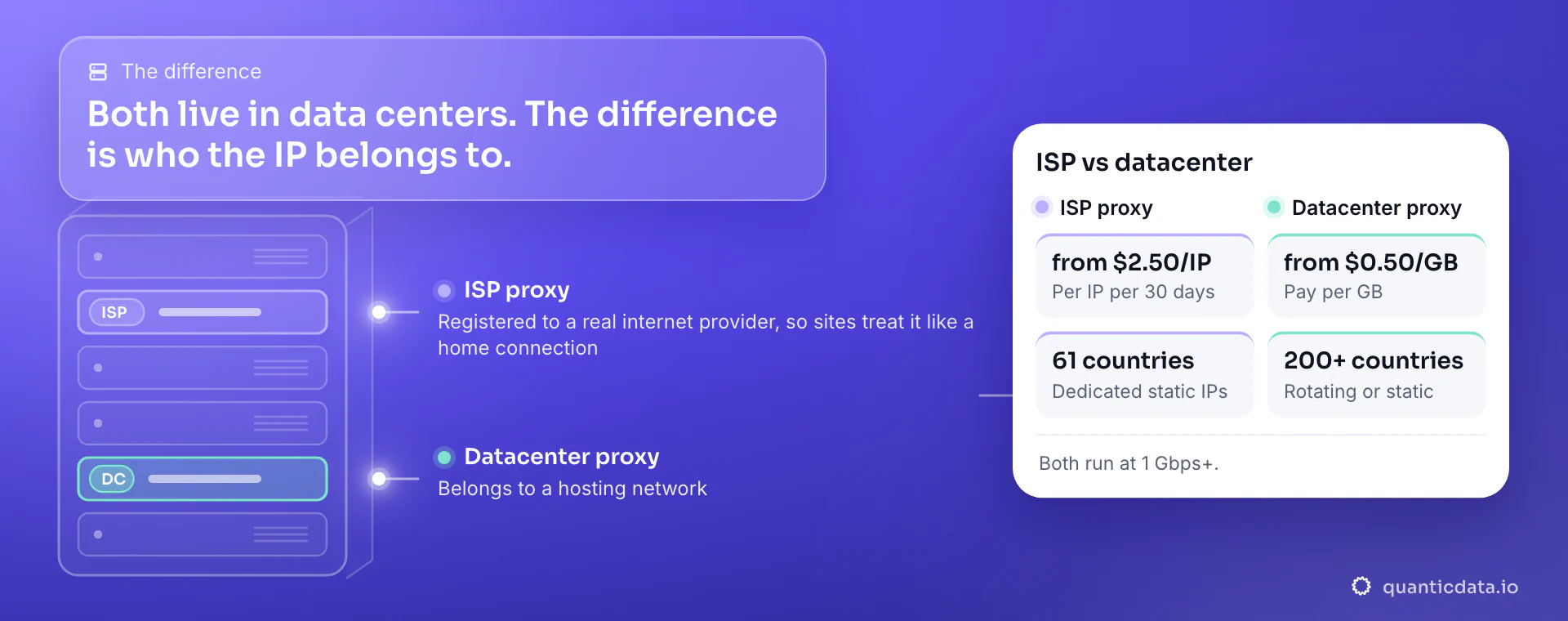
The difference
Who owns the address.
| ISP proxies | Datacenter proxies | |
|---|---|---|
| Whose IP | Registered to an internet provider, hosted in a data center | Belongs to a hosting network |
| What you pay for | Per IP, from $2.50 for 30 days | Per GB, $8 for 10 GB down to $0.50/GB; or unlimited bandwidth from $10 for 24 hours |
| Where | 61 countries, 221 cities; Premium lets you choose city and carrier | Per-GB plans: 200+ countries by country, state and city; unlimited: US, UK, CA, NL, DE |
| Sessions | One static IP for the term | Rotating or static |
| Protocols | HTTP, HTTPS, SOCKS5, UDP on every IP | HTTP, HTTPS, SOCKS5 |
| Identity checks | No KYC | No KYC |
How sites see them
IP type is a signal.
Many sites score an address by the network it belongs to. A datacenter range is recognised as hosting; an ISP address looks like a subscriber of that provider. For targets that check, ISP proxies pass where datacenter ones get challenged.
For targets that do not check (most APIs, many public pages, your own monitoring) datacenter is the cheaper way to move the same traffic.
Price
Fixed per IP, or by traffic.
An ISP proxy costs a fixed amount per IP for 30 days whatever traffic it carries. Datacenter is metered per GB ($8 for 10 GB, falling to $0.50/GB at 500 GB and 1 TB), or unmetered on dedicated plans: $10 for 24 hours, $50 for 7 days, $150 for 30 days.
Few addresses that must stay the same and carry steady traffic: ISP. Volume over many requests where the address type does not matter: datacenter.
Where each works
Pick by the target.
| Use | Pick | Why |
|---|---|---|
| Accounts on social or marketplaces | ISP | One provider-registered IP per account, for the whole term |
| Checkout, ticketing, sneaker releases | ISP | Static and trusted, fast enough for timed flows |
| Scraping sites that do not score IP type | Datacenter | Lowest cost per GB |
| Large downloads, testing, monitoring | Datacenter unlimited | Traffic not metered for the term |
| Sites that block hosting ranges | ISP or residential | Provider-registered or home IPs |
When the target blocks both, use residential proxies: home IPs in 228 countries and territories.
Before you choose
Questions buyers ask
Are ISP proxies datacenter proxies?
They are hosted in data centers, but the IP is registered to an internet provider, not to a hosting network. That registration is what makes sites treat them like home connections.
Which is faster?
Both run on data-center infrastructure; the practical difference is not speed but how targets treat the IP type.
Which is cheaper?
For traffic, datacenter: from $0.50 per GB, or unlimited from $10 for 24 hours. For a stable address, ISP: from $2.50 per IP for 30 days.
Can datacenter proxies be static?
Yes, per-GB plans run rotating or static sessions, and the unlimited plans are dedicated.
Do I need KYC for either?
No. Both are sold without KYC, paid by card, PayPal or crypto.
Pick the IP type your target accepts.
ISP from $2.50 per IP for 30 days, datacenter from $0.50 per GB or unlimited from $10 a day. Same account, same balance.