Compare · ISP vs residential
ISP proxies vs residential proxies
Both come from real internet providers. The difference is who holds the IP and for how long: an ISP proxy is one static IP that is yours for the term; a residential proxy is a home IP that rotates, or stays for a session you set. Price follows: per IP for ISP, per GB for residential.
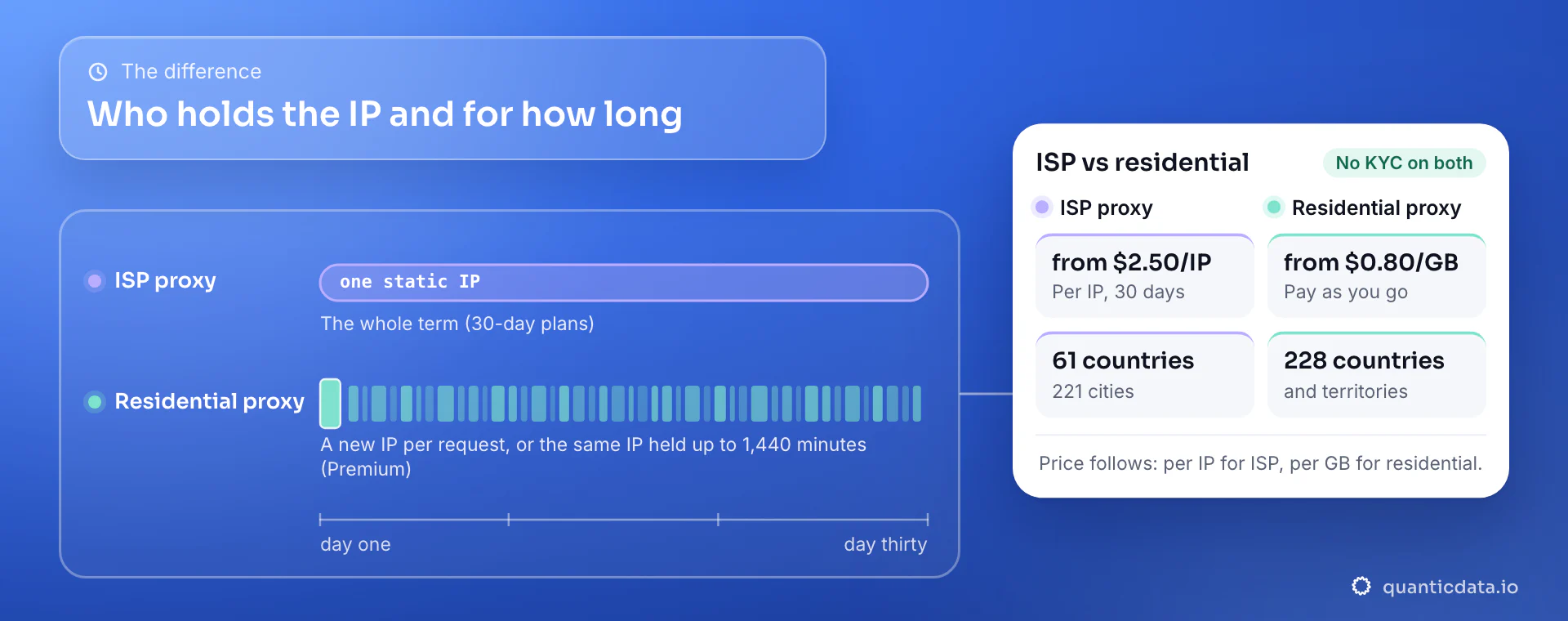
The difference
One table, six rows that decide it.
| ISP proxies | Residential proxies | |
|---|---|---|
| What the IP is | A static IP registered to an internet provider, dedicated to you | A home IP from a real device, shared across the pool |
| How long you keep it | The whole term (30-day plans) | A new IP per request, or the same IP held up to 1,440 minutes (Premium) |
| What you pay for | Per IP, from $2.50/IP | Per GB, from $0.80/GB, pay as you go |
| Where | 61 countries, 221 cities; Premium lets you choose city and carrier | 228 countries and territories; country, region/city and ASN filters |
| Protocols | HTTP, HTTPS, SOCKS5, UDP on every IP, ports 80 and 443 | HTTP, HTTPS, SOCKS5 |
| Identity checks | No KYC | No KYC |
Price
Per IP or per GB: the volume decides.
An ISP proxy costs a fixed amount for the term whatever you send through it: from $2.50 per IP for 30 days. Residential is metered: from $0.80 per GB, and the smallest Basic plan is 5 GB for $5, valid 30 days.
So the question is traffic per IP. A few IPs that carry a lot of traffic (logins, long sessions, downloads) cost less as ISP. Many requests spread over many IPs, with little traffic each (scraping, price checks, geo tests), cost less as residential.
Residential prices drop with volume: see residential proxy volume pricing. ISP prices by duration are in the ISP configurator.
Sessions
Static for the term, or sticky for as long as you set.
With an ISP proxy nothing rotates: the IP is the same on day one and day thirty, which is what accounts, carts and anything that remembers a device expect.
With residential you choose: a fresh IP on every request, or a sticky session that keeps the same home IP for up to 1,440 minutes on Premium. That covers a login and a checkout, but not a month.
If the target ties the account to the IP and you need it to stay the same for weeks, take ISP. If you need many identities in parallel, take residential.
Where each works
Pick by what the target checks.
| Use | Pick | Why |
|---|---|---|
| Running accounts, social or marketplace | ISP | One stable IP per account, for the whole term |
| Checkout and ticketing | ISP, or residential sticky | The session must not change IP mid-flow |
| Web scraping at scale | Residential | Many IPs, country and city filters, pay per GB |
| Ad verification and geo tests | Residential | Real home IPs in 228 countries and territories |
| Price monitoring, SERP checks | Residential or datacenter | Volume at the lowest price per GB |
| Large downloads on few IPs | ISP | No metering, UDP allowed |
The third option
Datacenter, when the target does not care.
Datacenter proxies start at $0.50/GB and are the fastest. They come from hosting networks, so targets that score IPs by type treat them differently from home and ISP IPs. For sites that do not check, they are the cheapest way to move traffic.
The full comparison across the three is on the residential proxies page.
Before you choose
Questions buyers ask
Are ISP proxies residential?
Yes in origin: the IP is registered to an internet service provider, like a home connection, which is why they are also called static residential proxies. The difference is that it sits in a data centre and is dedicated to you instead of rotating through a pool.
Is a static residential proxy the same as an ISP proxy?
Yes. Both names describe one dedicated IP registered to an internet provider that stays yours for the term.
Which is cheaper?
It depends on traffic per IP. ISP is a fixed price per IP from $2.50 for 30 days; residential is from $0.80 per GB. Few IPs with heavy traffic are cheaper as ISP; many light requests are cheaper as residential.
Can I use both on one account?
Yes. Plans are separate products on the same balance; you can run ISP IPs for accounts and residential for collection at the same time.
Do I need to verify my identity?
No KYC for either product. The KYC and sanctions policy applies only to unusual orders.
Pick one and start.
ISP from $2.50 per IP for 30 days, residential from $0.80 per GB with no subscription. Both without KYC, both on the same balance.