Unlimited residential proxies exist, but every such plan caps something other than gigabytes: port speed, threads, days or a fair-use limit, and a 100 Mbps port moves at most 1,080 GB a day. Rotating residential is usually sold per GB; unlimited bandwidth on one fixed IP is what ISP proxies sell.
"Unlimited" sounds like the end of the meter. In practice it moves the meter somewhere else. This page lays out the four ways residential access is priced, turns port speeds and thread counts into the gigabytes they can actually carry, and gives the arithmetic to decide when a flat plan beats paying per GB. The numbers come from our own published measurements, cited where they appear.
Unlimited residential proxies: the four ways they are priced
| Model | What you pay for | What limits you | Fits |
|---|---|---|---|
| Per GB | Traffic that passes through the gateway | Only the gigabytes you bought and their term | Rotating residential, any volume, uneven workloads |
| Per IP | One dedicated address for a period | One fixed IP per purchase, no rotation | Static residential (ISP) proxies for accounts and long sessions |
| Per port speed | A connection speed, in Mbps, for hours, days or a month | The speed and the time block | Steady, high-volume jobs that run all day |
| Per thread | A number of simultaneous connections for a period | How many requests can be open at once | Scrapers with a fixed degree of parallelism |
The searches people type show the same split: "unlimited residential proxies port", "unlimited residential proxies 1 day" and "unlimited static residential proxies" are three different products. Most plans also carry a fair-use clause, a limit written into the terms that applies when usage is far above what the provider expects for the price. Read it before you compare prices: it is the real cap of an "unlimited" plan.
Why rotating residential traffic is metered
A rotating residential exit is somebody's home connection. On a legitimate network, the people who share it have opted in and are compensated, and every gigabyte you move passes through their line. That is a cost per gigabyte, which is why rotating residential is normally sold per GB. A flat plan has to cover the same cost, so it limits throughput instead: a slower port, fewer threads, shorter time blocks, or a fair-use ceiling.
That is also why the sourcing question matters more on unlimited offers than on any other. Consent and compensation cost money, and an unusually cheap "unlimited rotating residential" pool is the classic sign that somebody else is paying for the bandwidth without knowing it. Ask where the IPs come from before you compare speeds; our post on how residential proxies can be legal lists the questions.
Static residential proxies are different. An ISP proxy is an address registered to a consumer internet provider but hosted on a server line, so the provider pays for the address, not per gigabyte of a household. That is why unlimited bandwidth is common there: you pay per IP, and the traffic on that IP is not metered.
What unlimited means at each port speed
A port-speed plan sells megabits per second. Converted to the gigabytes that per-GB plans bill, at full speed every second of the period (1 Mbps is 125,000 bytes per second; 1 GB is 1,000,000,000 bytes):
| Port speed | Per hour | Per day | Per 30 days |
|---|---|---|---|
| 10 Mbps | 4.5 GB | 108 GB | 3,240 GB |
| 50 Mbps | 22.5 GB | 540 GB | 16,200 GB |
| 100 Mbps | 45 GB | 1,080 GB | 32,400 GB |
| 1 Gbps | 450 GB | 10,800 GB | 324,000 GB |
These are ceilings. A scraper rarely keeps a port full: requests wait on the target, on the exit's home connection and on retries, so real throughput is a fraction of the line. The table is useful the other way round: if your job needs 40 GB a month, a plan that can carry 3,240 GB is mostly paying for capacity you will not use.
Threads: the cap you meet first
A thread-based plan limits how many connections you can have open at the same time. How many gigabytes that allows depends on how long each request takes. In our residential test of 13 September 2026, a 119,573-byte page took a median of 1.57 s from request to last byte through our residential gateway. One thread fetching that page back to back moves about 76 KB per second:
| Threads | Pages per hour | Traffic per hour | Traffic per day |
|---|---|---|---|
| 1 | about 2,300 | about 0.27 GB | about 6.6 GB |
| 10 | about 23,000 | about 2.7 GB | about 66 GB |
| 100 | about 230,000 | about 27 GB | about 660 GB |
Two things follow. On a thread plan, slow targets cost you, because a thread waiting on a slow page moves nothing. And a per-GB plan with no limit on connections has no such ceiling: QuanticData residential plans allow unlimited concurrent sessions, so parallelism is decided by your code and the target's tolerance, not by the plan.
Unlimited or per GB: which is cheaper for you
The break-even is one division: the flat fee divided by the price per GB gives the gigabytes a per-GB plan would buy for the same money. At our lowest Residential Basic rate of $0.80/GB, every $100 of flat fee equals 125 GB. What 125 GB buys depends on the page, so here it is in pages we measured and published:
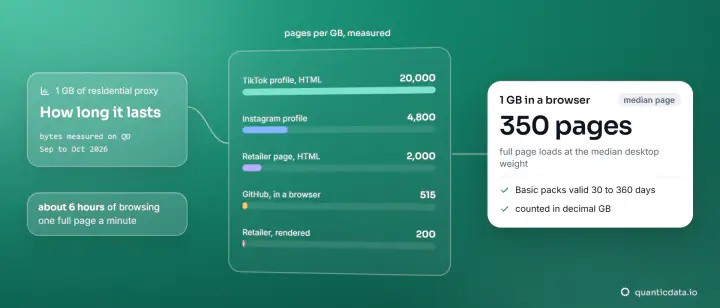
- Public Instagram profiles, 207 KB on the wire in the Instagram and TikTok test of 4 October 2026: about 600,000 profiles.
- A retailer home page fetched as HTML, 506,484 bytes for Best Buy in our 53-target measurement: about 250,000 pages.
If your monthly volume sits well below what the flat fee buys per GB, pay per GB. If you run steady, heavy traffic every day of the month, compare the flat plan's speed and thread caps with the tables above before you assume it is cheaper. The formula that turns a page count into gigabytes, with headers and retries, is in our guide on how much proxy data you need.
Questions to ask about any unlimited plan:
- What is capped: speed, threads, days, or a fair-use volume, and where is that written?
- Does the plan rotate home IPs per request, or is it a set of static addresses?
- Which countries and which targeting (state, city, ISP) are included at that price?
- Where do the IPs come from, and can the people who share them opt out?
- What happens to unused time: a 1-day pass that sits idle for a day is gone.
Where QuanticData plans sit in these four models
What we sell, as listed on our product pages:
| Product | Billed | Bandwidth | From |
|---|---|---|---|
| Residential Basic, rotating or sticky | Per GB, one-off packs, no subscription | Metered; unlimited concurrent sessions | $0.80/GB |
| Residential Premium, own location catalog and pool filters | Per GB, one-off packs | Metered; unlimited concurrent sessions | $2.20/GB |
| ISP proxies, dedicated static IPs | Per IP, per 30 days | Unlimited, with unlimited concurrent sessions | $2.50/IP |
| Datacenter proxies | Per GB | Metered | $0.50/GB |
Residential gigabytes have no monthly cap: you use them at your own pace over the plan term, 30 to 360 days depending on the pack. Every pack with its price per GB is on the residential volume pricing page. If the job needs unlimited traffic on a fixed address, that is the ISP line: ISP proxies, compared with other providers on the page of ISP proxies compared by criteria. For targets that do not check IP type, datacenter proxies cost less per GB again.
The setting to buy
For rotating collection at uneven volume: QuanticData residential proxies, Basic from $0.80/GB, country in the username, unlimited concurrent sessions, with a free 100 MB trial for 5 days (SMS verification, no card) to measure your own bytes per page first. For accounts and long sessions that should keep one address and never count gigabytes: ISP proxies from $2.50/IP per 30 days, unlimited bandwidth.