
Mobile proxies for Instagram and TikTok, measured on 4 October 2026: all 17 connected QuanticData mobile sessions exited on a carrier network in the requested country, across six countries, and returned 51 of 51 public Instagram profiles with a 1.21-second median time to first byte. On TikTok, 22 of 24 profile requests returned the profile.
Most pages about this topic sell a promise. This one is a log. We opened sticky sessions on our own 4G/5G network, fetched public profiles through each of them and kept the numbers. The summary by country is results-2026-10-04.csv.
What we tested, and what we did not
The test reads public, logged-out pages. We created no accounts, logged in to nothing, posted nothing and ran one request at a time. That is the only part of the question that can be measured honestly from outside: whether the page arrives, how fast, how heavy, and which network the site saw.
| Item | Setting |
|---|---|
| Date and time | 4 October 2026, 08:35 to 08:48 UTC |
| Network | QuanticData mobile (4G/5G), sticky sessions with a 10-minute lifetime, no carrier pinned |
| 3 public profiles per session, on the 17 connected sessions in the United States, United Kingdom, Germany, Brazil, India and Italy: 51 requests | |
| TikTok | 2 public profiles per session, 3 sessions each in the United States, United Kingdom, Germany and Brazil: 24 requests |
| Client | curl with an iPhone Safari user agent, redirects followed, 30-second limit |
| Success | HTTP 200 and the profile data in the HTML: the handle in Instagram's title tag, the user record in TikTok's page state |
Each session first read its own exit address through the proxy; we then looked that address up off-proxy on ip-api.com for country, network and its mobile flag. The profiles are large official accounts (Instagram, NASA, National Geographic, TikTok), chosen because they are public and stable.
What this does not measure: account safety, ban rates, posting, automation. Nobody can claim those numbers from a latency test, and we do not. For how the network itself behaves (geo match, sticky sessions, carriers, reputation of the exits) see our 98-request test of the mobile network.
Results at a glance
| Measure | Result |
|---|---|
| Exits on a carrier network in the requested country | 17 of 17 |
| Public Instagram profiles returned | 51 of 51 |
| Median time to first byte, Instagram | 1.21 s |
| Public TikTok profiles returned | 22 of 24 |
| Median time to first byte, TikTok | 1.69 s |
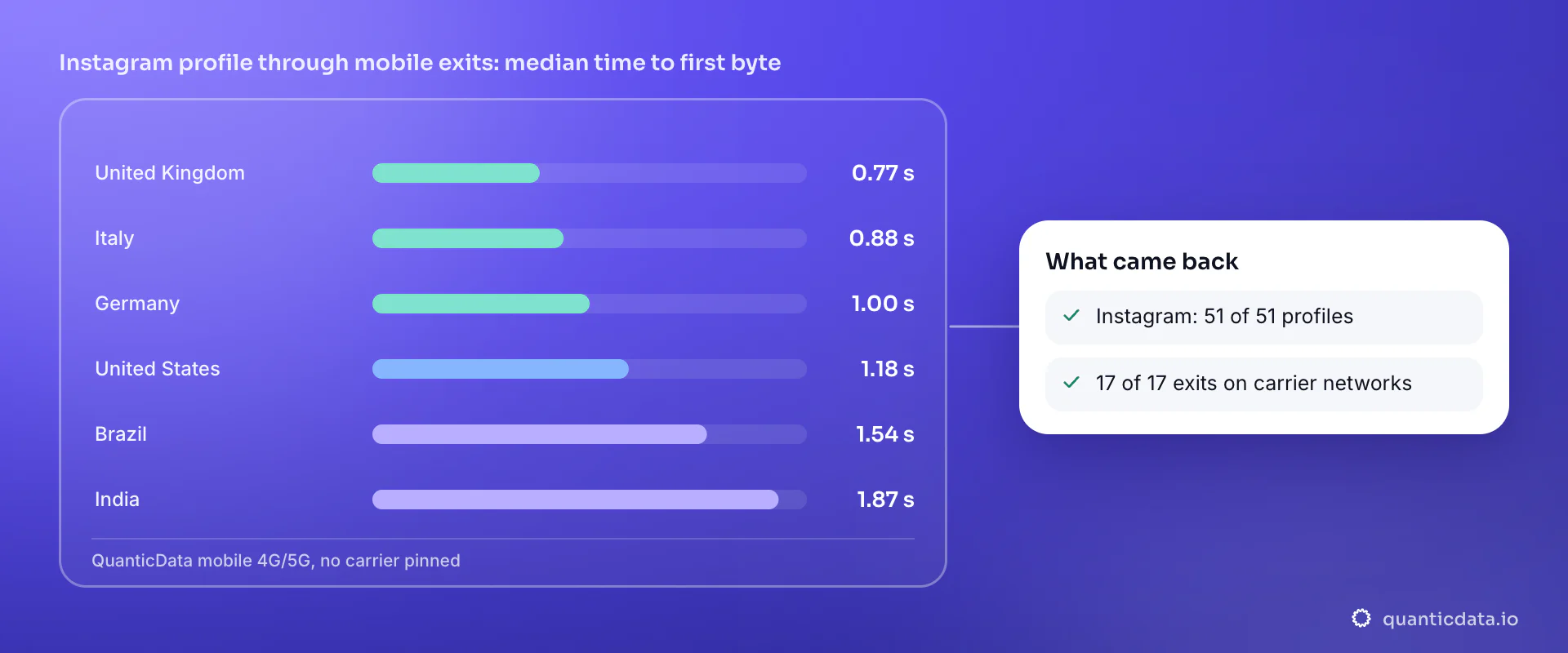
All 17 mobile exits were distinct addresses, all in the requested country, and ip-api.com flagged all 17 as mobile networks. Without pinning a carrier, the pool handed out Verizon and AT&T in the United States, Three and BT in the United Kingdom, O2 Telefonica in Germany, Claro and TIM in Brazil, Reliance Jio in India, WINDTRE and Iliad in Italy.
Instagram, country by country
| Country | Carriers seen | Profiles returned | Median TTFB |
|---|---|---|---|
| United States | Verizon, AT&T | 9 of 9 | 1.18 s |
| United Kingdom | Three, BT | 6 of 6 | 0.77 s |
| Germany | O2 Telefonica | 9 of 9 | 1.00 s |
| Brazil | Claro, TIM | 9 of 9 | 1.54 s |
| India | Reliance Jio | 9 of 9 | 1.87 s |
| Italy | WINDTRE, Iliad | 9 of 9 | 0.88 s |
| All six | 10 carriers | 51 of 51 | 1.21 s |
Time to first byte is the wait before the first byte of HTML arrives through the exit. Every profile returned the handle in the title tag and the follower count in the description: 687M followers for Instagram's own account, 104M for NASA, 268M for National Geographic, the same from every country. What those meta tags contain, and what they do not, is covered in what Instagram returns to a proxied client.
TikTok in four countries
Through mobile exits in the United States, the United Kingdom, Germany and Brazil, 22 of 24 public profile requests returned the profile, with a median time to first byte of 1.69 seconds. The exits were on Verizon, AT&T, Three, BT, O2 Telefonica, Claro and TIM.
A returned profile carries the account's record in the page state: the handle, the display name and the follower count, which is what a research or verification job reads. The structure of that page is described in TikTok measured from four countries.
Where mobile fits, and where residential is the cheaper tool
What a mobile exit gives you is identity. The site sees an address that belongs to a mobile operator and is shared by many real subscribers behind carrier-grade NAT, in the country, and optionally the carrier, you choose. That is the network a phone app normally comes from. In this run every one of the 17 exits was classified as a mobile network, across 10 carriers, without us asking for any carrier in particular.
That is why agencies that manage client accounts, verify ads by market or check how a campaign renders on a local carrier buy QuanticData mobile proxies: one sticky session per account keeps a consistent carrier address for the whole working session.
| Job | What we would use | Why |
|---|---|---|
| See a page as a local phone user does | Mobile, country in the username | 17 of 17 exits on carrier networks in the right country |
| Keep one network identity per client account | Mobile, one sticky session per account | Carrier address held for the session lifetime; account outcomes not measured here |
| Check ads and content by market and carrier | Mobile, country and carrier in the username | Named operators in each country |
| Collect public profiles in bulk | Residential, or the scraping API | Lower price per GB, or a price per page |
For bulk collection of public pages, where the carrier identity is not the point, residential proxies are the cheaper option per gigabyte, and the Web Scraping API does the fetch for you and bills per page.
One plain line on rules. Instagram's robots.txt disallows automated collection for user agents it does not list, and both platforms' terms restrict automated access and bulk collection. A proxy changes where a request comes from, not what you are allowed to do: stay on public data, keep volumes modest and respect each platform's terms.
What a page weighs and what 1,000 cost
Mobile bandwidth is sold per gigabyte, so the bill follows the page weight. With compression on, as any browser or HTTP client sends it:
| Page | Wire | Decoded | Per 1,000 | $5/GB | $2.30/GB |
|---|---|---|---|---|---|
| Instagram public profile | 207 KB | 1.05 MB | 0.207 GB | $1.03 | $0.48 |
| TikTok public profile | 49 KB | 202 KB | 0.049 GB | $0.25 | $0.11 |
Wire is the compressed size that is billed, and the last two columns price 1,000 pages at the entry rate and at the 500 GB rate. The entry pack is $5 for 1 GB valid 90 days, which is about 4,800 Instagram profile pages or 20,000 TikTok profile pages at these weights; the rate falls to $2.30 per GB at 500 GB. All packs are on the pricing page.
Limits of this test
- One morning, one client, three sessions per country: enough to see a pattern, not to promise a rate.
- Logged-out HTML only. We did not load the pages in a browser, open the apps or touch any account.
- Official accounts with very large audiences. Small or private profiles can answer differently.
- What a platform serves to logged-out visitors varies by country and changes over time; these are the results of 4 October 2026.
The setting to buy and how to call it
For the workflows above: the mobile network, the country in the username, one sticky session per account or per job, HTTP or SOCKS5. Host and port are in the dashboard once the pack is active; a session id you choose keeps the same exit until its lifetime ends.
curl -x "http://USER-country-us-sid-client01-ttl-30m:PASS@$PROXY_HOST" \
  -A "Mozilla/5.0 (iPhone; CPU iPhone OS 18_5 like Mac OS X) AppleWebKit/605.1.15 (KHTML, like Gecko) Version/18.5 Mobile/15E148 Safari/604.1" \
  --compressed -L "https://www.instagram.com/nasa/"
Change country-us to the market you need, and use a new sid for each account or job. Platform-specific setup, session lengths and the countries most requested are on the pages for mobile proxies for Instagram and mobile proxies for TikTok. Price: $5 for 1 GB, valid 90 days, no subscription.