How fast is a residential proxy? On 18 November 2026 we sent 1,800 requests through QuanticData rotating residential exits in 15 countries, from a client in Italy. 1,774 succeeded (98.6%). The median time to first byte was 0.96 s on both the Basic and the Premium line: 0.48 to 0.64 s for European exits, close to the client.
| Exit country | Median TTFB, Basic | Median TTFB, Premium |
|---|---|---|
| France | 0.50 s | 0.53 s |
| Netherlands | 0.51 s | 0.48 s |
| United Kingdom | 0.55 s | 0.53 s |
| Poland | 0.55 s | 0.61 s |
| Germany | 0.56 s | 0.55 s |
| Spain | 0.60 s | 0.63 s |
| Italy | 0.61 s | 0.64 s |
| Turkey | 0.84 s | 0.78 s |
| Canada | 1.08 s | 1.19 s |
| United States | 1.11 s | 1.12 s |
| Brazil | 1.19 s | 1.35 s |
| Mexico | 1.30 s | 1.17 s |
| India | 1.48 s | 1.24 s |
| Japan | 1.62 s | 1.51 s |
| Australia | 2.10 s | 1.82 s |
| All 15 | 0.96 s | 0.96 s |
Measured by us on 18 November 2026 between 15:38 and 15:49 UTC, one run, 60 requests per country on each line (20 to each of three small neutral pages). Basic numbers come from a Residential Basic plan and Premium numbers from a Residential Premium plan of the same account; neither is presented for the other. Over all countries 888 of 900 Basic and 886 of 900 Premium requests succeeded on the first attempt. The method and the limits are below; the medians per country, line and target are in residential-speed-by-country-2026-11-18.csv.
Median time to first byte by country, chart
Residential BasicResidential Premium
Three things stand out. Exits in the client's own region are the fastest: the seven European countries all sit between 0.48 and 0.64 s. Turkey follows at 0.84 s on Basic. The Americas come next, 1.08 to 1.35 s across both lines, and Asia-Pacific, the farthest from the client, comes last: India 1.48 s, Japan 1.62 s, Australia 2.10 s on Basic. That order follows distance from the machine that ran the test, which is why the same table run from New York would put the United States first. The lines are close to each other: Premium was faster in 8 countries and Basic in 7, mostly by a few hundredths of a second.
How fast are residential proxies compared with a direct connection?
The same three pages fetched from the same machine without any proxy answered in a median of 0.15 to 0.18 s (20 requests each). A residential exit in a nearby country therefore added about 0.30 to 0.49 s to the first byte. That cost is the route itself: the request goes to our gateway, then to a household connection in the chosen country, and only then to the website, and every new rotating exit needs its own TLS handshake with the site. Search results quote averages of 0.5 to 0.7 s for "fast" residential proxies; in this run the European exits, near the client, sat in that range.
| Path | Median time to first byte | What it includes |
|---|---|---|
| Direct, no proxy (baseline) | 0.15 to 0.18 s | Client in Italy to the website's nearest edge |
| Residential exit in Europe | 0.48 to 0.64 s | Gateway, household connection, TLS with the site |
| Residential exit in the Americas | 1.08 to 1.35 s | The same, plus an ocean crossing each way |
| Residential exit in Asia-Pacific | 1.24 to 2.10 s | The longest physical route from the client |
Do residential proxies exit in the requested country?
One of the three targets, Cloudflare's public trace page, prints the country it sees. On the Basic line 298 of 299 successful trace requests showed the requested country; on the Premium line 297 of 297. Every rotating trace request also came from a different address: 299 distinct exits on Basic and 297 on Premium, one per request. We count addresses through a one-way hash and do not publish them.
Spread, total time and TLS by country
The median says how fast a typical request is; the 90th percentile (p90) says how slow the slow ones get. The table adds the median total time of a request and the moment the TLS handshake with the website finished.
| Exit country | p90 TTFB, Basic | p90 TTFB, Premium | Median total, Basic | Median total, Premium | Median TLS done, Basic | Median TLS done, Premium |
|---|---|---|---|---|---|---|
| France | 0.67 s | 0.94 s | 0.51 s | 0.54 s | 0.35 s | 0.39 s |
| Netherlands | 0.77 s | 0.81 s | 0.51 s | 0.49 s | 0.37 s | 0.35 s |
| United Kingdom | 3.79 s | 1.59 s | 0.55 s | 0.56 s | 0.39 s | 0.40 s |
| Poland | 0.88 s | 1.07 s | 0.55 s | 0.61 s | 0.38 s | 0.44 s |
| Germany | 1.25 s | 1.06 s | 0.56 s | 0.56 s | 0.39 s | 0.40 s |
| Spain | 1.20 s | 1.86 s | 0.60 s | 0.63 s | 0.41 s | 0.46 s |
| Italy | 0.92 s | 1.00 s | 0.61 s | 0.65 s | 0.44 s | 0.48 s |
| Turkey | 1.34 s | 1.26 s | 0.86 s | 0.79 s | 0.54 s | 0.56 s |
| Canada | 1.39 s | 2.84 s | 1.10 s | 1.26 s | 0.73 s | 0.87 s |
| United States | 3.17 s | 2.52 s | 1.11 s | 1.15 s | 0.73 s | 0.83 s |
| Brazil | 1.93 s | 2.55 s | 1.20 s | 1.39 s | 0.79 s | 0.99 s |
| Mexico | 1.87 s | 3.65 s | 1.32 s | 1.20 s | 0.84 s | 0.82 s |
| India | 2.56 s | 6.07 s | 1.50 s | 1.30 s | 0.95 s | 0.91 s |
| Japan | 4.31 s | 1.87 s | 1.67 s | 1.53 s | 1.05 s | 1.08 s |
| Australia | 2.88 s | 3.13 s | 2.13 s | 1.90 s | 1.27 s | 1.33 s |
The p90 column is the request slower than nine in ten. It ran from 1.2 to 6.9 times the median, depending on the country and the line: a rotating exit is a different household connection on every request, and a few of them are slow. If your job has a hard deadline per request, size it on the p90, not the median.
How we measured
- When: 18 November 2026, 15:38:34 to 15:48:49 UTC for the 1,800 proxied requests, 15:49 to 15:54 UTC for the 60 direct ones. One run.
- From where: one Windows machine on a home broadband connection in Italy (Cloudflare served it from its Milan location).
- What: the QuanticData Residential Basic and Residential Premium lines, rotating (a new exit per request), country set in the username, no pool filter on Premium. Each round alternated the two lines, so both saw the same minutes.
- Targets: three small public pages chosen because they have nothing to block and are served from edges in every region: www.cloudflare.com/cdn-cgi/trace (about 250 bytes, it also reports the country), www.wikipedia.org (the portal page) and example.com. 20 requests to each, per country, per line.
- Client: curl_cffi 0.17.0 with the Chrome 152 profile, one request at a time per country, 0.5 s between requests, the 15 countries in parallel, redirects followed, no retries.
- Success: HTTP 2xx and the page's own text present (the country line for the trace page, the Wikipedia logo block, the "Example Domain" heading).
- Time to first byte (TTFB): libcurl's start-transfer time: connection to the gateway, the tunnel to the exit, the TLS handshake with the website and the server's reply. The table reports medians of successful requests.
- Data: residential-speed-by-country-2026-11-18.csv holds one row per country and line (requests sent, median and p90 time to first byte, median total and TLS times, the median per target) and the direct baseline.
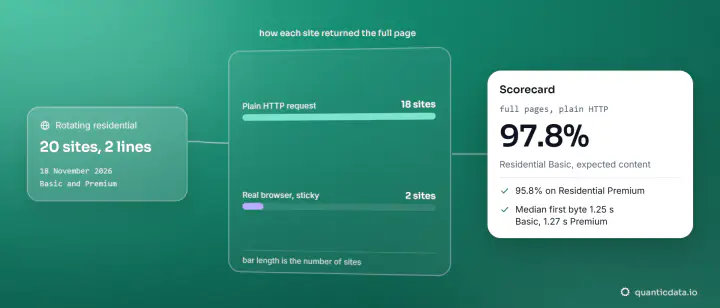
Which real websites returned the full page through the same two lines is in residential proxy success rate by website, and our September test of the Premium line covered ten countries with sticky sessions and fraud scores.
What this test does not show
- One afternoon in Europe, one client. Residential exits are household connections, and their speed changes with the hour in the exit country (evening is peak time at home).
- Speed from your location. Every number includes the distance from Italy; run the same test from your own servers before you plan capacity.
- Heavy pages. The targets are a few kilobytes; on a 1 MB page the total time also depends on the exit's bandwidth.
- Websites with bot protection. Whether a site serves the page is a different question, measured per site in residential proxy success rate by website.
- Cities, ISPs, sticky sessions and the Premium pool filters (Speed, Quality). They were not used here.
- Other providers. We measured our own network only and make no comparison.
Which exit country to pick, and what to buy
Pick the exit country the website expects its visitors to come from, not the fastest one: a page in the wrong country is a wrong page, however fast it arrived. Then put your workers near that country if latency matters, and run requests in parallel. Both lines target every country above; Premium adds ISP targeting and pool filters, Basic costs less per gigabyte, and both are on residential proxy pricing. Start with the free residential trial, read the country pages (United States, United Kingdom, Germany, France, Italy, Spain, Brazil, India, Japan and all residential proxy countries), and when the numbers fit your job, buy residential proxies on the line you tested. The product page for both lines is QuanticData residential proxies, and the rotation modes are explained on rotating proxies.