SERP API · Google Trends
Google Trends API
Google Trends as JSON: the interest-over-time series for a keyword in a country, and, without a keyword, the searches trending now with their traffic and articles. This is the SERP API with search_type: "trends", billed per search.
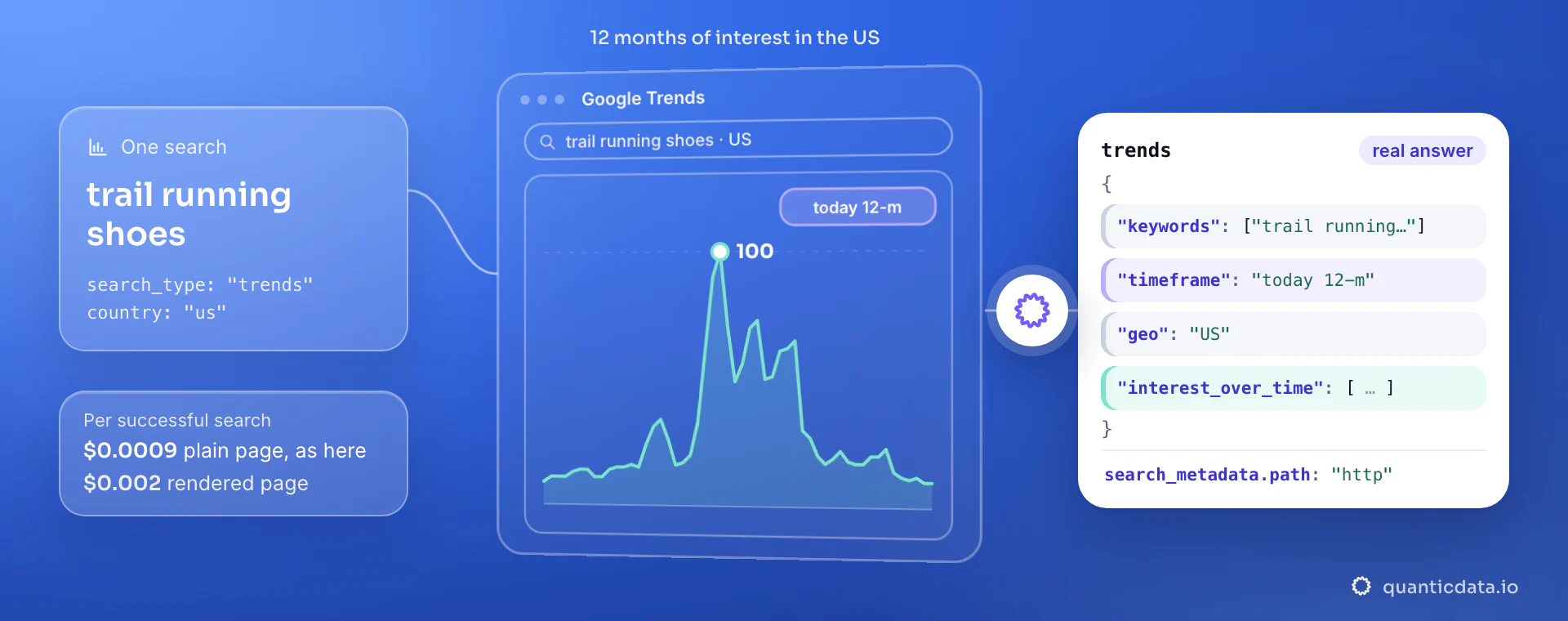
What you get
A series, or a list of trending searches.
| Field | What it holds |
|---|---|
trends.keywords | The keywords compared |
trends.timeframe | Period ("today 12-m") |
trends.geo | Country |
trends.interest_over_time[].date | Week or day |
trends.interest_over_time[].timestamp | Unix time |
trends.interest_over_time[].value | Interest, 0 to 100 |
trending.searches[].query | A search trending now (no keyword sent) |
trending.searches[].approx_traffic | Traffic band ("100+") |
trending.searches[].articles | News articles about it |
Interest is relative, as on trends.google.com: 100 is the peak of the period, not a number of searches.
Example
One request, one JSON answer.
curl -X POST https://api.quanticdata.io/v1/scraper/serp \
  -H "Authorization: Bearer YOUR_API_KEY" \
  -H "Content-Type: application/json" \
-d '{"query":"trail running shoes","search_type":"trends","country":"us"}'import requests
r = requests.post("https://api.quanticdata.io/v1/scraper/serp",
headers={"Authorization": "Bearer YOUR_API_KEY"},
json={"query": "trail running shoes", "search_type": "trends", "country": "us"})
for p in r.json()["payload"]["trends"]["interest_over_time"]:
print(p["date"], p["value"]){
"keywords": [
"trail running shoes"
],
"timeframe": "today 12-m",
"geo": "US",
"interest_over_time": [
{
"date": "Oct 26 – Nov 1, 2025",
"timestamp": 1761436800,
"value": 9
},
{
"date": "Nov 2 – 8, 2025",
"timestamp": 1762041600,
"value": 11
},
{
"date": "Nov 9 – 15, 2025",
"timestamp": 1762646400,
"value": 11
}
]
}The answer is the usual envelope: payload.trends holds the list above, payload.search_metadata says which tier answered and how long it took.
Parameters
Which keyword, where.
| Parameter | Meaning |
|---|---|
query | The keyword; leave it out for the searches trending now |
country | Proxy exit and Google locale (gl), ISO code: us, gb, de, it… |
lang | Interface language (hl): en, de, it… |
device | desktop (default), mobile, ios or android |
Every parameter, for every vertical, is in the API reference.
Price
Per search, nothing monthly.
A successful search costs $0.0009 when Google's plain page answers and $0.002 when the rendered page is needed; search_metadata.path in the answer says which one you got. In our test on 30 October 2026 the call answered from the plain page in 5.18 seconds.
Failed searches are not charged. There is no subscription: a $2 free credit every month covers the first calls, then you top up your balance by card, PayPal or crypto.
If you would rather pay per trend than per search, the Google Trends — trending now collector returns the same data at $0.0005 per delivered trend (up to 20 per run), with no pagination to handle.
Every price per search and per vertical: SERP API pricing.
Official API or this one
Trends, as data.
Google Trends shows interest over time and trending searches on trends.google.com.
This endpoint returns the same series and lists as JSON for the country you choose, billed per successful search; the Google Trends collector reads the trending-now list per trend.
Use cases
What teams build with it.
Seasonality: when demand for a product peaks, by country.
Content timing: what is rising now, with the articles behind it.
Market sizing signals: relative interest between markets for the same keyword.
Before you call it
Questions developers ask
Is the value a number of searches?
No. As on trends.google.com it is relative interest, 0 to 100, where 100 is the peak of the period.
Can I get the searches trending now?
Yes, call trends without a query: trending.searches lists them with traffic band and articles.
How fast is a call?
About 5 seconds for a keyword series in our test on 30 October 2026, about 1 second for the trending list.
Which countries?
Any country code Google Trends supports, through country.
What does it cost?
$0.0009 per search from the plain page, which is how Trends answered in our test.
Start with the free credit.
Create an API key, run the example above and read the JSON. Pay per search after the $2 monthly credit, no subscription.