Free or paid · Before you pay
Free vs paid proxies: what the price buys you
A free proxy is a public address that someone left open or a list scraped from the web: nobody answers for who runs it, what it logs or how long it lasts. A paid proxy is a known network, a login only you hold and a price per GB or per IP. You can test ours before paying: 100 MB of residential for 5 days, no card.
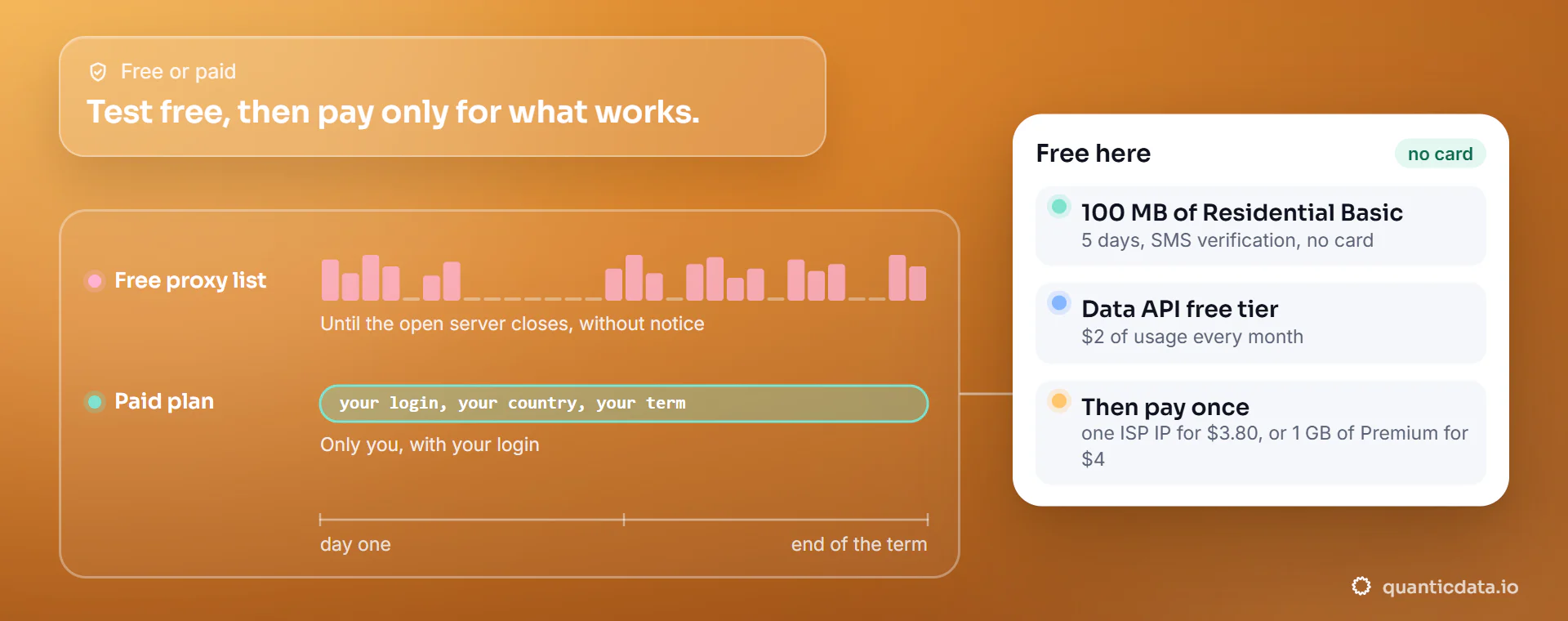
Side by side
A free list, a free trial and a paid plan.
| Free proxy list | QuanticData free trial | Paid plan | |
|---|---|---|---|
| Who runs the proxy | Unknown | QuanticData | QuanticData |
| Who can use it | Anyone who finds the list | Only you, with your login | Only you, with your login |
| Lifetime | Until the open server closes, without notice | 5 days or 100 MB | The term of the plan, 30 to 360 days |
| Targeting | Whatever country it happens to be in | Country, state, city, rotating or sticky | Country to city, ISP, carrier, sessions |
| Cost | $0, paid in risk and time | $0, SMS verification, no card | From $4 for 1 GB or $3.80 for one IP |
What a free proxy costs
Four costs that do not show on the price.
- Your traffic passes through a stranger. An open proxy can read and change anything not encrypted end to end, and log the sites you visit. Never send a password, a session cookie or customer data through one.
- The addresses are already burned. Public lists are crawled by thousands of people; the sites you care about have usually seen and blocked those IPs before you arrive.
- It dies mid-job. Open proxies disappear without notice, so a scraper on a free list spends its time testing and replacing addresses rather than collecting pages.
- No choice of place or session. You get the country the server happens to be in, with no sticky session, no city and nobody to ask when it fails.
Lists sold as "fresh" or "unblocked" proxies are the same open servers checked more often: the address is still public and still shared with everyone who downloaded the list.
What is free here
Enough to test on your own targets.
| Offer | What it includes | Conditions |
|---|---|---|
| Residential proxy trial | 100 MB of Residential Basic | 5 days, SMS verification, no card |
| Data API free tier | $2 of usage every month on the SERP, scraping and collector APIs | Every account, renewed monthly |
| Free tools | Proxy tester, proxy location checker, IP fraud score check | In the browser, no account |
Use the 100 MB on the pages you will really collect, from the countries you need: check that the exit is in the right city and that the pages load. The proxy tester checks an exit from the browser. Details on the free proxy trial.
The smallest paid plans
What the first payment buys on each network.
| Network | Smallest plan | Valid |
|---|---|---|
| Residential Premium | 1 GB for $4 | 30 days |
| Mobile 4G/5G | 1 GB for $5 | 90 days |
| ISP (static, dedicated) | One IP for $3.80 | 30 days |
| IPv6 | 100 GB for $20 | 30 days |
| Residential Basic | 25 GB for $25 ($1.00 per GB) | 30 days |
| Datacenter | $0.80 per GB on the smallest pack | 30 days |
Every plan is paid once, by card, PayPal, 300+ cryptocurrencies or the account balance, with no subscription and no identity check; crypto and balance payments carry no VAT. More on pay-as-you-go proxies and on the pricing page.
Before you pay
Questions buyers ask
Are free proxies safe?
Not for anything that matters. The operator of an open proxy is unknown and can read or change unencrypted traffic and log what you visit. Use one only for public pages, and never with a login, a cookie or customer data.
Why are free proxies so slow?
Thousands of people use the same public list at once, the servers were not set up to carry that traffic, and many addresses are dead or blocked. Most of the time goes into finding one that still works.
Can I use a free proxy for web scraping?
For a few test requests on a site that does not block, perhaps. For a real job the addresses are usually blocked already and die mid-run; a pool priced per GB costs from $0.50 per GB on datacenter.
Is there a free proxy trial?
Yes: 100 MB of Residential Basic for 5 days, with SMS verification and no card. The data APIs also give every account $2 of free usage each month.
What is the cheapest paid proxy to start with?
One ISP IP for 30 days at $3.80, 1 GB of Residential Premium at $4, or 1 GB of mobile at $5. For volume, Residential Basic starts at 25 GB for $25 and datacenter at $0.80 per GB.
Are paid proxies worth it?
When the job has to finish: a paid proxy gives you a login only you hold, the country and city you choose, sessions that hold, and someone to ask when it fails. Test on the free trial first and pay only if your targets work.
Test free, then pay only for what works.
100 MB of residential for 5 days with no card, then plans from $3.80 for one ISP IP or $4 for 1 GB. Paid once, no subscription, no KYC.