Collectors · Research & science
World Bank API in Python
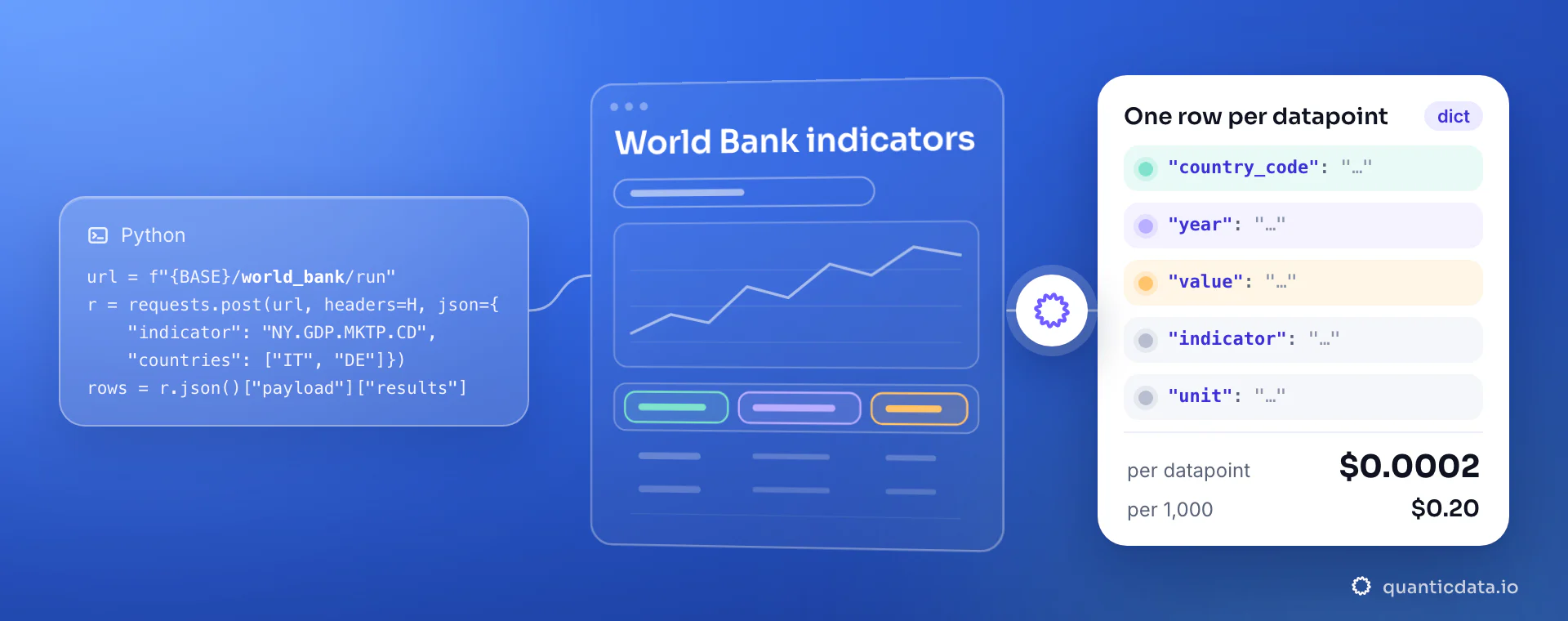
Development indicators per country and year — GDP, population, inflation and ~16k more. One POST from Python with indicator and countries, rows back as JSON with 10 fields, $0.0002 per delivered datapoint. No proxies or parsers to maintain.
First call
Install, call, read the rows.
pip install requestsimport os, requests
r = requests.post(
"https://api.quanticdata.io/v1/scraper/collectors/world_bank/run",
headers={"Authorization": f"Bearer {os.environ['QD_API_KEY']}"},
json={
"indicator": "<indicator>",
"countries": "<countries>",
},
timeout=120,
)
r.raise_for_status()
run = r.json()["payload"]
print(run["count"], "rows,", run["cost"]["usd"], "USD")
for row in run["results"]:
print(row.get("country"), row.get("country_code"), row.get("year"), row.get("value"))The key comes from an environment variable, never from the code. The run answers in the same request when it finishes in time; payload.results holds the rows and payload.cost what they cost.
Request parameters
What the collector takes.
| Parameter | Type | Required | Meaning |
|---|---|---|---|
indicator | string | yes | World Bank indicator code. |
countries | array | yes | ISO2/ISO3 country codes. |
year_from | integer | no | First year (default: all). |
year_to | integer | no | Last year (default: latest). |
include_empty | boolean | no | Keep rows whose value is null. |
max_results | integer | no | How many datapoints to deliver at most (1–200). You pay only for delivered datapoints. |
Response fields
10 fields per datapoint.
| Field | Type | What it holds |
|---|---|---|
rank | integer | 1-based position. |
country | string, nullable | Country name. |
country_code | string, nullable | ISO3 code. |
year | string, nullable | Year. |
value | number, nullable | Indicator value. |
indicator | string | Indicator code. |
indicator_name | string, nullable | Indicator label. |
country_iso2 | string, nullable | ISO 3166-1 alpha-2 country code. |
unit | string, nullable | Unit, when the Bank states one. |
obs_status | string, nullable | Observation status flag, when present. |
Add ?format=csv to the runs endpoint to get the same rows as CSV.
Long runs
Run in the background, then poll.
A run that needs more time can go to the background: send "async": true, get 202 with the run id, and poll the runs endpoint until the status is done. Reading a run is free.
import os, time, requests

H = {"Authorization": f"Bearer {os.environ['QD_API_KEY']}"}
r = requests.post("https://api.quanticdata.io/v1/scraper/collectors/world_bank/run", headers=H,
                  json={**{"indicator":"<indicator>","countries":"<countries>"}, "async": True}, timeout=30)
run_id = r.json()["payload"]["run_id"]
while True:
    run = requests.get(f"https://api.quanticdata.io/v1/scraper/collectors/runs/{run_id}", headers=H, timeout=30).json()["payload"]
    if run["status"] in ("done", "failed"):
        break
    time.sleep(5)
print(run["status"], run["count"])Errors
What can come back, and what is billed.
| Status | Meaning | Billed |
|---|---|---|
400 | The input does not match the collector (payload.errors) | No |
401 | Missing or wrong API key | No |
402 | Balance and free credit do not cover the run: top up | No |
422 | The input can never resolve; retrying the same input cannot help | No |
424 | The run failed at the source (blocked, timed out, layout changed); safe to retry | No |
429 | Rate limit or a per-account brake; wait for Retry-After | No |
Only delivered rows are billed: a run that delivers nothing costs nothing.
Price
$0.0002 per delivered datapoint.
| Rows | Cost |
|---|---|
| 1 | $0.0002 |
| 1,000 | $0.20 |
| 10,000 | $2.00 |
Up to 200 datapoints per run; split larger jobs into several runs. The $2 free credit every month covers about 10,000 datapoints. No subscription; paid tiers lower the unit price. All collector prices: collector pricing.
Before you run it
Questions developers ask
Is there a free World Bank indicators API?
Every account gets $2 of free usage each month, about 10,000 datapoints of this collector at $0.0002 each, with no card.
Do I have to handle proxies, retries or blocks?
No. The collector runs on our network and handles them; a run blocked at the source returns 424 and is not billed.
How many rows can one run return?
Up to 200 datapoints per run (the max_results input, where the collector has one).
Can an AI agent run it?
Yes: the MCP server exposes it as the run_collector tool, with the same input and price. See the MCP server.
Run it on the free credit.
Create an API key, export it as QD_API_KEY and run the example. $0.0002 per delivered datapoint, no subscription.