Collectors · Lead generation
Healthgrades Scraper API in Python
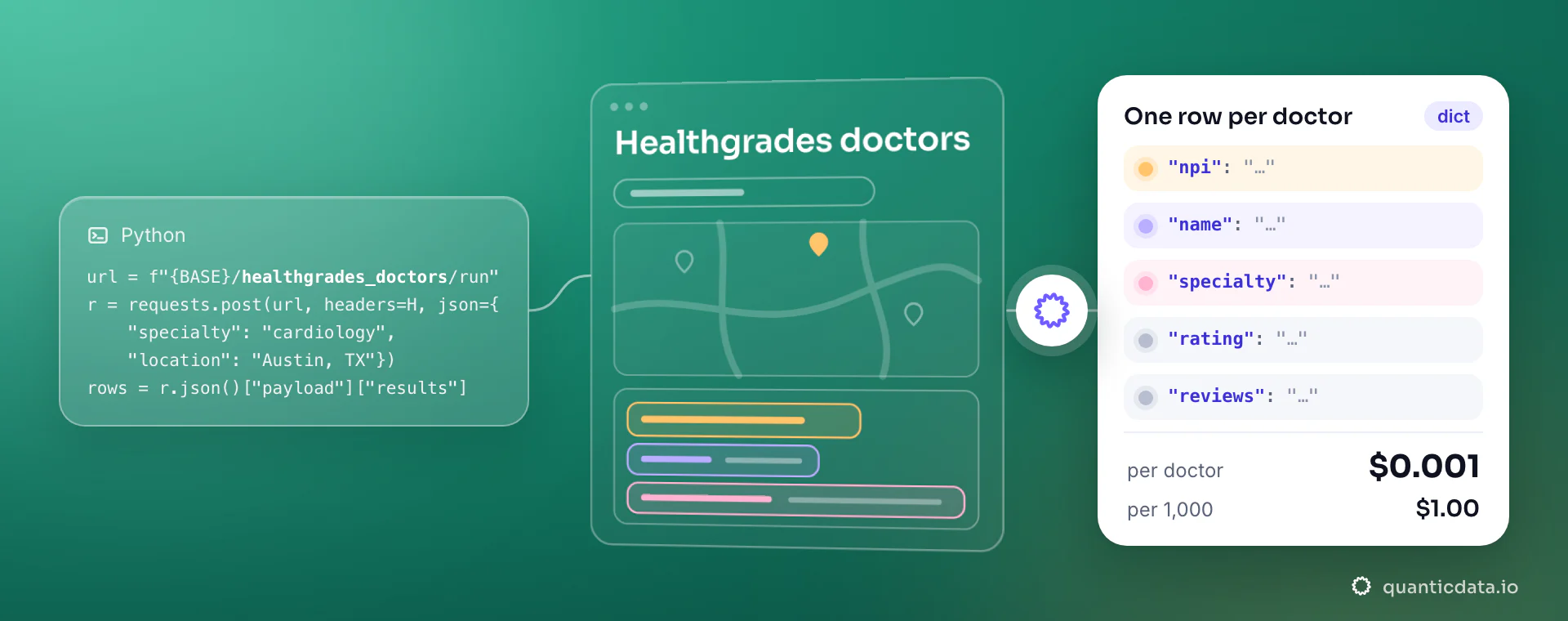
Doctors for a specialty in a US location — rating, review count, practice, address, phone, accepting new patients. One POST from Python with specialty and location, rows back as JSON with 41 fields, $0.001 per delivered doctor. No proxies or parsers to maintain.
First call
Install, call, read the rows.
pip install requestsimport os, requests
r = requests.post(
"https://api.quanticdata.io/v1/scraper/collectors/healthgrades_doctors/run",
headers={"Authorization": f"Bearer {os.environ['QD_API_KEY']}"},
json={
"specialty": "cardiology",
"location": "Austin, TX",
"max_results": 40,
},
timeout=120,
)
r.raise_for_status()
run = r.json()["payload"]
print(run["count"], "rows,", run["cost"]["usd"], "USD")
for row in run["results"]:
print(row.get("provider_id"), row.get("npi"), row.get("name"), row.get("specialty"))The key comes from an environment variable, never from the code. The run answers in the same request when it finishes in time; payload.results holds the rows and payload.cost what they cost.
Request parameters
What the collector takes.
| Parameter | Type | Required | Meaning |
|---|---|---|---|
specialty | string | yes | Specialty, condition or procedure to search for, e.g. "cardiology", "dentistry", "family medicine" or "knee replacement". |
location | string | yes | US city and state or ZIP code, e.g. "Austin, TX" or "33139". |
country | string | no | ISO 3166-1 alpha-2 code — proxy exit geo and Google locale (gl). Omit for the default pool. |
max_results | integer | no (default 20) | How many doctors to deliver at most (1–200). You pay only for delivered doctors. |
Response fields
41 fields per doctor.
| Field | Type | What it holds |
|---|---|---|
rank | integer | 1-based position across the merged pages, sponsored cards first as the page renders them. |
provider_id | string, nullable | Healthgrades provider id (pwid) — the key in the profile URL and the de-duplication key. |
npi | string, nullable | National Provider Identifier. |
name | string | Doctor's name with credentials, e.g. "Dr. Norman Risinger, MD". |
specialty | string, nullable | Primary specialty, e.g. "Cardiology". |
specialties | string[], nullable | All specialist descriptions Healthgrades lists, e.g. ["Internist", "Cardiology Specialist"]. |
rating | number, nullable | Patient satisfaction rating out of 5. Null when Healthgrades suppresses surveys for the row. |
reviews | integer, nullable | Number of patient ratings behind the score. |
written_reviews | integer, nullable | How many of those ratings include a written review. |
accepting_new_patients | boolean, nullable | Whether the doctor accepts new patients, as Healthgrades states it. |
telehealth | boolean, nullable | Whether virtual visits are offered. |
phone | string, nullable | The practice's phone number as published. Never a sponsor call-tracking number, and null when Healthgrades hides the phone for that placement. |
practice | string, nullable | Office or practice name, e.g. "Austin Heart - South". |
address | string, nullable | Full address on one line. |
street | string, nullable | Street line only. |
city | string, nullable | City. |
state | string, nullable | US state code. |
zipcode | string, nullable | ZIP code. |
latitude | number, nullable | Office GPS latitude. |
longitude | number, nullable | Office GPS longitude. |
distance_miles | number, nullable | Distance in miles from the searched location, as Healthgrades computes it. |
gender | string, nullable | Gender as Healthgrades publishes it ("M" / "F"). |
years_experience | integer, nullable | Years in practice, rounded. Healthgrades states it on a minority of rows; null elsewhere. |
sponsored | boolean | True for the featured cards Healthgrades places above the results — real doctors, but paid placements that repeat on every page of the search. |
url | string, nullable | Healthgrades profile URL. |
image | string, nullable | Profile photo URL. |
phones | string[], nullable | Every phone number of the displayed office; `phone` is the first. |
insurance_accepted | string[], nullable | Insurance plans the provider accepts, as Healthgrades lists them. |
offices_count | integer, nullable | Number of office locations on the profile. |
about | string, nullable | Provider biography, up to 1,200 characters. |
care_philosophy | string, nullable | Care philosophy statement, up to 800 characters. |
patient_highlights | string[], nullable | What patients most often say went well, e.g. "Listened/answered questions". |
rating_percent | integer, nullable | The rating expressed on a 0–100 scale, as Healthgrades computes it. |
same_day_appointments | boolean, nullable | True when same-day appointments are offered. |
next_day_appointments | boolean, nullable | True when next-day appointments are offered. |
evening_appointments | boolean, nullable | True when evening appointments are offered. |
saturday_appointments | boolean, nullable | True when Saturday appointments are offered. |
telehealth_only | boolean, nullable | True when the provider only offers telehealth visits. |
healthgrades_choice | boolean, nullable | True when the provider holds the Healthgrades Choice recognition. |
top_hospital_affiliation | boolean, nullable | True when affiliated with a hospital Healthgrades ranks as a top hospital. |
years_since_graduation | integer, nullable | Years since medical school graduation, when stated. |
Add ?format=csv to the runs endpoint to get the same rows as CSV.
Long runs
Run in the background, then poll.
A run that needs more time can go to the background: send "async": true, get 202 with the run id, and poll the runs endpoint until the status is done. Reading a run is free.
import os, time, requests

H = {"Authorization": f"Bearer {os.environ['QD_API_KEY']}"}
r = requests.post("https://api.quanticdata.io/v1/scraper/collectors/healthgrades_doctors/run", headers=H,
                  json={**{"specialty":"cardiology","location":"Austin, TX","max_results":40}, "async": True}, timeout=30)
run_id = r.json()["payload"]["run_id"]
while True:
    run = requests.get(f"https://api.quanticdata.io/v1/scraper/collectors/runs/{run_id}", headers=H, timeout=30).json()["payload"]
    if run["status"] in ("done", "failed"):
        break
    time.sleep(5)
print(run["status"], run["count"])Errors
What can come back, and what is billed.
| Status | Meaning | Billed |
|---|---|---|
400 | The input does not match the collector (payload.errors) | No |
401 | Missing or wrong API key | No |
402 | Balance and free credit do not cover the run: top up | No |
422 | The input can never resolve; retrying the same input cannot help | No |
424 | The run failed at the source (blocked, timed out, layout changed); safe to retry | No |
429 | Rate limit or a per-account brake; wait for Retry-After | No |
Only delivered rows are billed: a run that delivers nothing costs nothing.
Price
$0.001 per delivered doctor.
| Rows | Cost |
|---|---|
| 1 | $0.001 |
| 1,000 | $1.00 |
| 10,000 | $10.00 |
Up to 200 doctors per run; split larger jobs into several runs. The $2 free credit every month covers about 2,000 doctors. No subscription; paid tiers lower the unit price. All collector prices: collector pricing.
Before you run it
Questions developers ask
Is there a free Healthgrades doctors API?
Every account gets $2 of free usage each month, about 2,000 doctors of this collector at $0.001 each, with no card.
Do I have to handle proxies, retries or blocks?
No. The collector runs on our network and handles them; a run blocked at the source returns 424 and is not billed.
How many rows can one run return?
Up to 200 doctors per run (the max_results input, where the collector has one).
Can an AI agent run it?
Yes: the MCP server exposes it as the run_collector tool, with the same input and price. See the MCP server.
Run it on the free credit.
Create an API key, export it as QD_API_KEY and run the example. $0.001 per delivered doctor, no subscription.