Collectors · App stores
Google Play scraper API in Python
Google Play app detail by package name — rating, reviews, category, price. One POST from Python with packages, rows back as JSON with 26 fields, $0.006 per delivered app. No proxies or parsers to maintain.
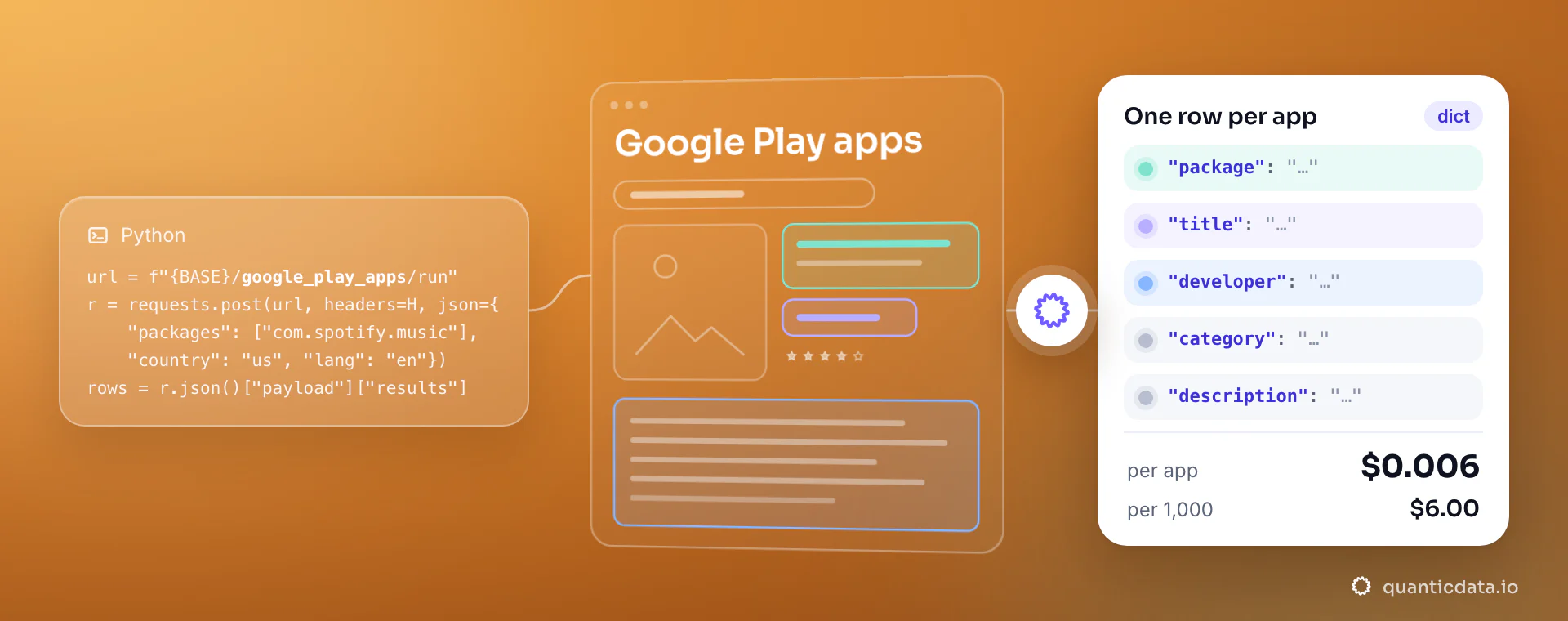
First call
Install, call, read the rows.
pip install requestsimport os, requests
r = requests.post(
"https://api.quanticdata.io/v1/scraper/collectors/google_play_apps/run",
headers={"Authorization": f"Bearer {os.environ['QD_API_KEY']}"},
json={
"packages": ["com.spotify.music","com.whatsapp"],
"country": "us",
"lang": "en",
"max_results": 10,
},
timeout=120,
)
r.raise_for_status()
run = r.json()["payload"]
print(run["count"], "rows,", run["cost"]["usd"], "USD")
for row in run["results"]:
print(row.get("package"), row.get("title"), row.get("developer"), row.get("developer_url"))The key comes from an environment variable, never from the code. The run answers in the same request when it finishes in time; payload.results holds the rows and payload.cost what they cost.
Request parameters
What the collector takes.
| Parameter | Type | Required | Meaning |
|---|---|---|---|
packages | array | yes | Android package names (com.spotify.music) or Play store URLs. |
country | string | no | ISO 3166-1 alpha-2 code — picks the local site AND the proxy exit (default us). |
lang | string | no | Interface language (hl), e.g. en, it, de. |
max_results | integer | no (default 10) | How many apps to deliver at most (1–50). You pay only for delivered apps. |
Response fields
26 fields per app.
| Field | Type | What it holds |
|---|---|---|
package | string | Android package name. |
title | string | App name. |
developer | string, nullable | Developer name. |
developer_url | string, nullable | Developer page URL. |
category | string, nullable | Play category. |
description | string, nullable | Store description (trimmed). |
rating | number, nullable | Average rating. |
reviews | integer, nullable | Rating count. |
price | number, nullable | Numeric price (0 = free). |
currency | string, nullable | Currency code. |
content_rating | string, nullable | Content rating. |
operating_system | string, nullable | Target OS. |
installs | string, nullable | Install band when the page shows one. |
icon | string, nullable | Icon URL. |
url | string | Localized store URL. |
full_description | string, nullable | The full store description (up to 6000 characters). |
genres | string[] | Genre chips shown on the page. |
screenshots | string[] | Screenshot URLs at original size (up to 12). |
updated | string, nullable | "Updated on" date as shown. |
updated_at | string, nullable | The same date as YYYY-MM-DD. |
in_app_purchases | boolean | True when the page says the app has in-app purchases. |
contains_ads | boolean | True when the page says the app contains ads. |
editors_choice | boolean | True when the app carries the Editors' Choice badge. |
developer_id | string, nullable | Developer id on Google Play. |
availability | string, nullable | Offer availability (InStock…). |
free | boolean, nullable | True when the price is 0. |
Add ?format=csv to the runs endpoint to get the same rows as CSV.
Long runs
Run in the background, then poll.
A run that needs more time can go to the background: send "async": true, get 202 with the run id, and poll the runs endpoint until the status is done. Reading a run is free.
import os, time, requests

H = {"Authorization": f"Bearer {os.environ['QD_API_KEY']}"}
r = requests.post("https://api.quanticdata.io/v1/scraper/collectors/google_play_apps/run", headers=H,
                  json={**{"packages":["com.spotify.music","com.whatsapp"],"country":"us","lang":"en","max_results":10}, "async": True}, timeout=30)
run_id = r.json()["payload"]["run_id"]
while True:
    run = requests.get(f"https://api.quanticdata.io/v1/scraper/collectors/runs/{run_id}", headers=H, timeout=30).json()["payload"]
    if run["status"] in ("done", "failed"):
        break
    time.sleep(5)
print(run["status"], run["count"])Errors
What can come back, and what is billed.
| Status | Meaning | Billed |
|---|---|---|
400 | The input does not match the collector (payload.errors) | No |
401 | Missing or wrong API key | No |
402 | Balance and free credit do not cover the run: top up | No |
422 | The input can never resolve; retrying the same input cannot help | No |
424 | The run failed at the source (blocked, timed out, layout changed); safe to retry | No |
429 | Rate limit or a per-account brake; wait for Retry-After | No |
Only delivered rows are billed: a run that delivers nothing costs nothing.
Price
$0.006 per delivered app.
| Rows | Cost |
|---|---|
| 1 | $0.006 |
| 1,000 | $6.00 |
| 10,000 | $60.00 |
Up to 50 apps per run; split larger jobs into several runs. The $2 free credit every month covers about 333 apps. No subscription; paid tiers lower the unit price. All collector prices: collector pricing.
Before you run it
Questions developers ask
Is there a free Google Play apps API?
Every account gets $2 of free usage each month, about 333 apps of this collector at $0.006 each, with no card.
Do I have to handle proxies, retries or blocks?
No. The collector runs on our network and handles them; a run blocked at the source returns 424 and is not billed.
How many rows can one run return?
Up to 50 apps per run (the max_results input, where the collector has one).
Can an AI agent run it?
Yes: the MCP server exposes it as the run_collector tool, with the same input and price. See the MCP server.
Run it on the free credit.
Create an API key, export it as QD_API_KEY and run the example. $0.006 per delivered app, no subscription.