To get SaaS customers in 2026, become a source AI assistants cite when buyers ask what to buy. On 30 October 2026 we read 47 answers from six assistants to 17 buying questions: 61% of their citations went to "best" and "cheapest" ranking pages. Be retrievable, answer with dated numbers, get onto those lists, measure every 14 to 30 days.
This guide is for founders and small teams selling software. It starts with what we measured, then gives a nine-step playbook, a way to measure it, and a 30-day plan. The classic channels are still in it, in the place where they still pay.
Where buyers look first in 2026
A buyer who needs software no longer starts with ten blue links. They ask ChatGPT, Perplexity, Gemini, Copilot or the AI Overview at the top of Google. They read one answer and open the two or three sources it names. The shortlist exists before they reach your site.
Those answers are not written from memory. The assistant runs a search, retrieves a handful of pages and rewrites them into one answer. Google Search Central states it plainly: to be shown as a supporting link in AI Overviews or AI Mode, a page must be indexed and eligible to appear in Google Search with a snippet. OpenAI's crawler documentation says that sites which block OAI-SearchBot will not be shown in ChatGPT search answers.
So the chain is short: search index, retrieved pages, answer, citation, click. A page the index does not return for the question cannot be cited, however good it is.
The AI layer already sits on a large share of buying searches. On 30 October 2026 we read the Google results for 280 buying queries in the United States, Germany, Spain and France, across four software categories. An AI Overview topped 91 of them, 32.5%.
What we measured: who the assistants cite
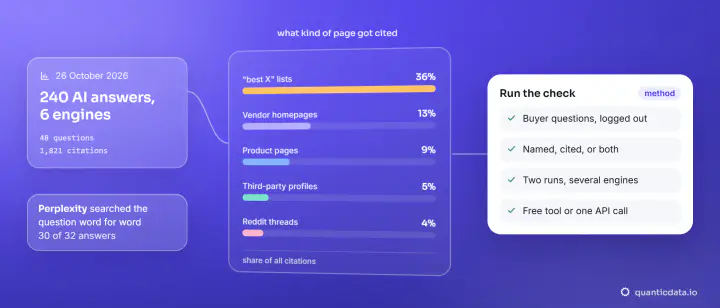
The same day we asked six assistants 17 questions a buyer asks before paying for a tool: the cheapest pay-as-you-go option, the best API with a free tier, the best service for a custom data set. The assistants were ChatGPT, Perplexity, Gemini, Grok, DeepSeek with search, and Claude with web search. The categories were proxies, scraping tools, search APIs and data sets. We kept every citation of the 47 answers.
| What we counted, 30 October 2026 | Result |
|---|---|
| Answers read | 47, from 6 assistants, to 17 buying questions |
| Citations in those answers | 213, to 196 distinct pages |
| Citations to "best", "cheapest", "top" or comparison pages | 130 of 213 (61%) |
| Cited rankings written by a vendor on its own blog | 62 pages |
| Rankings among the 20 most cited pages | 16 of 20 |
| Google buying queries with an AI Overview | 91 of 280 (32.5%) |
| Queries with the same top 10 as the day before | 6 of 280 |
Three patterns came out of it.
- The assistants copy lists. Most citations went to pages titled "best X 2026" or "cheapest X", and many of those lists were written by a vendor about its own market; the other 83 went to product pages, docs, media and forums. If you are not on the lists, you are rarely in the answer.
- Outside the lists, numbers win. The product pages that were cited directly answered the exact question with a figure: a price per row, a count of cities and countries, the size of a free sample, a date.
- The ground moves every day. Between 29 and 30 October only 6 of the 280 Google result pages kept the same ten results in the same order, and each query gained about 3.4 new domains. One reading is a sample, not a position.
This is a snapshot of four categories on one day, with one answer per assistant and question. It shows what the answers lean on. It does not rank anyone.
Why a polished page can still be invisible
Most advice about AI visibility is about the page: schema, FAQ, short answers, llms.txt. All of it helps. None of it matters if the page is not retrieved.
In our audits, pages that passed almost every on-page check were still capped when Google did not return them for their own question. They had crawler access, text without JavaScript, structured data, an answer-first opening, a date and an author. The engine never retrieved them, so it never quoted them.
That is why the audit behind our AI Visibility API checks retrieval first. It searches Google for the page's own H1 question, looks for the URL in the top 10 and checks whether it is indexed at all. A page that is not indexed is reported as a blocker, and the blocker caps the score. Fix that first. Then polish.
The playbook: nine steps a founder can run
In the order in which they move results. Each step fits in a month without an agency.
- Write down the 10 questions buyers ask before they pay. Take them from Google and Bing autocomplete, your sales calls and your support tickets: "best X for Y", "cheapest X", "X with a free tier", "X vs Y". These are the questions the assistants answer, and the ones you will measure.
- Give each question one page, and make that page retrievable. Put the question in the title and the H1. Link the page from your strongest pages: home, pricing, docs. Keep a self-referencing canonical, list the page in the sitemap and check that Google and Bing have indexed it. Copilot answers from Bing's index, and IndexNow tells Bing about a new or changed URL the same day.
- Answer in the first 60 words, with a number and a date. Open with the answer, not a story. Follow with a table of what the buyer compares: price, limits, coverage, free tier. Date the figures. In our sample, the product pages cited outside the lists were the ones that answered with a figure.
- Publish something only you can measure. A benchmark on your own product, a data set from your own logs, a test with the method written out. The GEO study by Aggarwal et al. (KDD 2024) found that edits to a source can raise its visibility in generative engine answers by up to 40%, and adding statistics, quotations and citations were among the most effective.
- Mark it up. A visible FAQ that matches FAQPage structured data, an Organization with sameAs links, an author with a profile page, datePublished and dateModified. It tells the engine what the page is and who stands behind it.
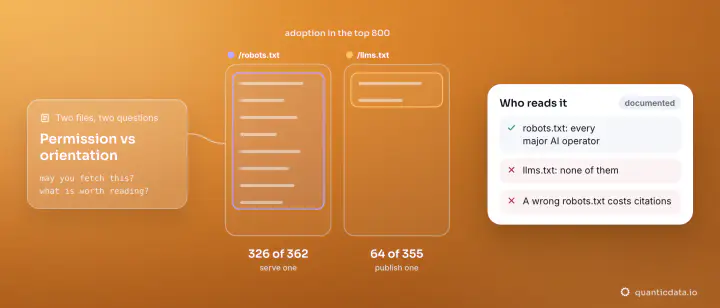
- Let the AI crawlers in and give them text. Allow OAI-SearchBot, PerplexityBot and Claude-SearchBot in robots.txt. Serve the text in the HTML, not only after JavaScript. Publish an llms.txt and a Markdown copy of your key pages. Our own measurements of top sites cover which AI crawlers top sites block, how much text AI crawlers lose without JavaScript and how many sites publish a real llms.txt.
- Get onto the lists the assistants copy. Find the "best X 2026" pages the engines cite for your questions; a citation panel lists them. Ask their authors to include you and give them the facts they need: price, free tier, limits, a test account. Answer real threads on Reddit, publish a short YouTube walk-through, collect reviews where your buyers read them. This is outreach with a target list, not link building.
- Measure every 14 to 30 days, and read twice. Run an AI visibility audit on each page and a citation panel with your 10 questions on more than one engine. Answers and result pages move from one day to the next, so read each panel twice and judge the trend over several runs.
- Keep the classic channels that still pay. Founder-led outreach, communities where your buyers ask for help, a comparison page against the tool you replace, referrals from your first users. They bring the first customers while the AI work compounds, and they create the mentions the assistants read later.
How to measure it: AI visibility first, rank tracking second
Rank tracking tells you where a URL sits in Google's list. A buyer who asks an assistant never sees that list. What you need to know is whether the answer names you, whether it links you, and whom it cites when it does not.
| Question | Rank tracking | AI visibility audit and citation panel |
|---|---|---|
| Can AI crawlers read my page? | No | Yes: 24 AI user agents in robots.txt, a fetch as GPTBot, text without JavaScript |
| Is the page retrievable for its question? | Position only | Rank for its own H1 question, and whether it is indexed |
| Does the answer name my brand? | No | Yes, per question and engine |
| Which of my URLs are cited, and where? | No | Yes, with the rank among cited domains |
| Who wins where I am absent? | The URLs above mine | The domains cited instead of mine |
Start with the free AI visibility audit: paste a URL, no account. It fetches the page the way an AI crawler does, scores the five things that decide whether an assistant can quote it, names the blocker that caps the score, and asks one live answer engine your question.
For the panel, the AI Visibility API asks ChatGPT search, Google AI Overviews and DeepSeek up to 10 questions in one call. For every answer it returns whether your brand was mentioned, which of your URLs were cited and at what rank, then the share of voice across all cited domains and the domains that win where you are absent. It costs $0.01 per audit plus $0.01 per answer: 10 questions on two engines is at most $0.21 a run, and four runs a month, $0.84, fit inside the $2 of free API usage per month every account gets. Agents call the same thing as the ai_visibility tool of the MCP server.
Keep rank tracking with the SERP API for what it does well: raw positions by city and device, at $0.0009 per search. It is the second screen, not the first.
What to spend less on. Daily rank reports for questions your buyers now put to an assistant. A tenth post on a topic before the first one is retrievable. Paid tools that track positions but cannot tell you who the answer cites.
A 30-day plan
| Week | Do | Done when |
|---|---|---|
| 1 | List the 10 buying questions. Run the free audit on the pages that should answer them. Fix the blockers: robots.txt, noindex, text that exists only after JavaScript. | Every page passes crawler access and serves its text without JavaScript |
| 2 | Rewrite the openings: the answer in 60 words, a table, dates. Add the FAQ and its structured data. Submit the URLs through IndexNow and check indexing. | Each page is indexed in Google and Bing |
| 3 | Publish one first-hand measurement. Send your facts to the authors of 5 lists the engines cite. | One new data set or test is live, 5 requests sent |
| 4 | Run the citation panel: 10 questions, 2 engines, read twice. Save it as the baseline. | Baseline saved, next run in 14 days |
The setting to start with
One call with your page, your 10 buying questions, two engines, your brand, two or three competitor domains and your main country: 20 answers for $0.21 at most, covered by the $2 of free API usage per month. Run it from cron, n8n or an agent every 14 days and keep each response as a dated snapshot.
curl https://api.quanticdata.io/v1/scraper/ai-visibility \
  -H "Authorization: Bearer $QD_API_KEY" \
  -H "Content-Type: application/json" \
  -d '{ "url": "https://example.com/pricing/",
        "queries": ["best invoicing app for freelancers",
                    "invoicing software with recurring billing"],
        "engines": ["openai", "deepseek"],
        "brand": "Example",
        "competitors": ["rival-one.example", "rival-two.example"],
        "country": "us" }'
Before you write any code, check one page with the free AI visibility audit or with the AI crawler access checker. If the page is blocked or not retrievable, the panel will only confirm it.
Sources & further reading
- Google Search Central: AI features and your website (technical requirements for AI Overviews and AI Mode)
- OpenAI: Overview of OpenAI crawlers (OAI-SearchBot and ChatGPT search)
- Aggarwal et al., GEO: Generative Engine Optimization (KDD 2024)
- IndexNow protocol: notify search engines of new and changed URLs
- llms.txt: a proposal for an LLM-readable site index
- Schema.org: FAQPage