Beijing
- Beijing — city targeting with
-region-beijing-city-beijing.
China mobile proxies are real 4G/LTE/5G carrier IPs with carrier and city targeting, sticky sessions up to 24 hours and plans from $5 for 1 GB.
Pay as you go · No subscription · No KYC
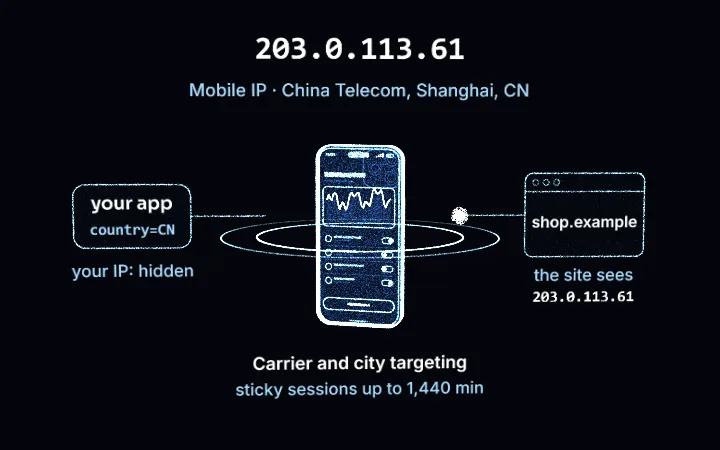
Carriers in the pool include China Telecom, China Unicom and China Mobile. Pay as you go, per GB, no subscription: $5 for 1 GB down to $2.30/GB at 500 GB, valid 90 days.
Rotating or sticky · up to 1,440 minutes (24 hours)
On we tested -country-cn, Shanghai, Beijing, Guangzhou and each carrier on our mobile gateway: China Mobile exited on AS9808, China Unicom on AS4808, China Telecom on AS4134.
3 Chinese carriers · Rotating or sticky · HTTP, HTTPS and SOCKS5
A proxy whose exit IP belongs to a Chinese mobile carrier and sits on a real 4G/LTE/5G device. Carriers place thousands of subscribers behind each shared address (carrier-grade NAT, RFC 6598), so a site that blocked it would lock out crowds of genuine Chinese customers — which is why platforms almost never do. The China pool spans 3 operators: China Telecom, China Unicom and China Mobile.
Country, carrier and session go in the username. Credentials are in your dashboard after purchase.
# PROXY_HOST = host:port shown in your dashboard
# rotating, any Chinese carrier
curl -x "$PROXY_HOST" -U "USER-country-cn-type-mobile:PASS" https://ipinfo.io/json

# one carrier
curl -x "$PROXY_HOST" -U "USER-country-cn-isp-china_telecom-type-mobile:PASS" https://ipinfo.io/json

# sticky session, 30 minutes
curl -x "$PROXY_HOST" -U "USER-country-cn-type-mobile-sid-a1b2c3-ttl-30m:PASS" https://ipinfo.io/jsonPer GB, 90-day terms, carrier targeting included. Every card opens the plans page.
Pay from balance, card, PayPal or crypto — card orders under $30 are charged and activated instantly. Terms up to 360 days on request.
The code goes after -isp- in the username. Leave it out to rotate across all of them.
Catalog, measured. On 20 September 2026 the mobile targeting catalog listed 194 countries and territories, 604 regions and 994 cities, with a selectable carrier in 140 countries (410 operators in total). We added China to it on 27 October 2026, after checking the exits on our own mobile gateway: country targeting, Shanghai, Beijing and Guangzhou as region and city, and China Mobile, China Unicom and China Telecom as carriers. The mobile pool exceeds 500k IPs worldwide; the catalog counts locations, not IPs per country, and we do not publish a per-country IP figure. How this network compares with other providers: best mobile proxies, by criteria.
-isp-china_telecom
-isp-china_unicom
-isp-china_mobile
The Mobile generator uses separate Country · Region · City and Country · ISP modes. ISP names below are city catalog associations, not combined city-and-ISP filters or live IP inventory.
-region-beijing-city-beijing.-region-guangdong-city-guangzhou.Anything that treats a phone on a carrier network as the most trustworthy visitor: app-store and social-media checks, sneaker drops, TikTok and Instagram account work, ad verification on Chinese carriers.
Cheaper household IPs for China are on the residential proxies page, and every network for the country is on the China proxy locations page. Static IPs: ISP proxies.
Looking for the cheapest 4G mobile proxies in China? QuanticData sells China mobile bandwidth from $5 for 1 GB, and the rate falls to $2.30/GB on the 500 GB package — the same pool of real China Telecom, China Unicom and China Mobile phones at every tier, not a cheaper “lite” pool. There is no port fee, no device rental and no monthly minimum, so a small test costs exactly $5. 4G/LTE and 5G exits sit in the same pool: the radio depends on the handset at that moment, and both look identical to a website — a Chinese carrier IP with a mobile ASN. Carrier, region and city targeting are included in the price.
Every China exit is a real subscriber connection on China Telecom, China Unicom and China Mobile: the IP is one the carrier assigned to a phone, shared through carrier-grade NAT with thousands of other real users. That is what the best 5G mobile proxies with real carrier IPs have in common, and it is why QuanticData does not sell a separate “5G-only” tier — no honest provider can promise which radio a subscriber’s phone is attached to. To pin a carrier, add its code to the username: USER-country-cn-isp-china_telecom-type-mobile gives you China Telecom only, USER-country-cn-type-mobile rotates across all 3. Rotating is the default; a sticky session (-sid-a1b2c3-ttl-30m) keeps the same IP for up to 1,440 minutes.
QuanticData bills China mobile proxies strictly per GB — mobile proxy pay as you go per GB, with no subscription, no monthly plan and no auto-renewal. You buy a package once ($5 for 1 GB, $20 for 5 GB, $35 for 10 GB, $75 for 25 GB, $250 for 100 GB, $1,150 for 500 GB) and the bandwidth stays valid for 90 days; when it runs out you simply buy another. Pay from balance, card, PayPal or crypto (crypto and balance carry no VAT); card orders under $30 are activated instantly. No KYC paperwork and no contract: an email address, a package and the credentials appear in your dashboard.
The best mobile proxies for Instagram and TikTok are the ones that share an address with thousands of real phones, because a platform that blocked that IP would lock out its own Chinese users. QuanticData’s China pool gives each account a China Telecom, China Unicom and China Mobile exit that looks like a subscriber on a Chinese network, which is what these apps expect from a phone. Use a sticky session per account (USER-country-cn-type-mobile-sid-<id>-ttl-30m) so logins, uploads and browsing stay on one IP, and rotate between accounts. Region and city targeting (-region-shanghai-city-shanghai for Shanghai) help when a profile should appear local. Every account still needs realistic behaviour: the proxy makes the network layer credible, it does not automate the app.
Measured on our own network: in the Instagram and TikTok test of 4 October 2026, 17 of 17 QuanticData mobile exits across six countries came out on a carrier network in the requested country, and 51 of 51 public Instagram profiles loaded, with a 1.21-second median time to first byte. Setup by platform: mobile proxies for Instagram and mobile proxies for TikTok.
If you are ranking the best mobile proxy providers 2026 for China, here is what you can verify about QuanticData without trusting a review: 3 named Chinese carriers you can select in the username (China Telecom, China Unicom and China Mobile); a published per-GB price list ($5.00 → $2.30/GB) with no ports, subscriptions or KYC; rotating or sticky sessions up to 24 hours; region and city targeting on the same credentials; HTTP, HTTPS and SOCKS5 on one gateway. The same account also covers residential, ISP, datacenter and IPv6 proxies plus the Web Scraper, SERP and Collector APIs, so China mobile traffic is one line in a wider toolkit rather than a separate vendor. Test it for $5 on your real targets before committing volume.
For the side-by-side view, see the best mobile proxies in 2026, ranked by criteria.
China mobile proxies: cheapest 4G, 5G carrier IPs, pay as you go, Instagram and TikTok, how to buy.
Something else? Ask usQuanticData’s China 4G/5G mobile proxies start at $5 for 1 GB and drop to $2.30/GB on 500 GB, billed per GB with no port fees or device rental. Every package uses the same pool of real China Telecom, China Unicom and China Mobile phones, so the entry tier is not a lower-quality pool — it is simply less bandwidth.
QuanticData’s China pool is made of real subscriber connections on China Telecom, China Unicom and China Mobile, shared through carrier-grade NAT with genuine phones. Whether a given exit is on a 4G/LTE or 5G cell depends on the handset at that moment; both show a real Chinese carrier IP with a mobile ASN, and you can pin a carrier with -isp-china_telecom in the username.
QuanticData bills China mobile proxies strictly per GB: buy 1 GB for $5 (or 5, 10, 25, 100 or 500 GB down to $2.30/GB) and use it within 90 days — no subscription, no monthly minimum, no auto-renewal. Pay from balance, card, PayPal or crypto; no KYC documents are requested.
QuanticData’s China mobile proxies are built for exactly that use: each account gets a real China Telecom, China Unicom and China Mobile IP shared with thousands of Chinese phones, held on a sticky session for up to 1,440 minutes so logins and uploads stay on one address. Region and city targeting let a profile appear local to Shanghai or any other listed city.
QuanticData publishes what other providers make you ask for: 3 named Chinese carriers selectable in the username, a per-GB price list from $5.00 down to $2.30/GB, rotating or sticky sessions up to 24 hours, region and city targeting, HTTP/HTTPS/SOCKS5 on one gateway, and no KYC. The same account covers residential, ISP, datacenter and IPv6 proxies and the scraping APIs.
QuanticData sells China mobile bandwidth from the dashboard: create a free account, open Plans → Mobile, pick a package from 1 GB ($5) to 500 GB ($1,150) and pay from balance, card, PayPal or crypto. The host, port and username appear immediately; add -country-cn and optionally -isp-china_telecom, -region-shanghai or -city-shanghai to the username, followed by -type-mobile, to target China.
Same pool, same username format: change the country code and the carrier.
Free account, pick a package, credentials in your dashboard. Mobile starts at $5 for 1 GB.
Buy China mobile bandwidth Create a free accountSession controls & IP quality
Mobile and Residential Premium both support configured sticky sessions up to 1,440 minutes (24 hours). Choose rotating mode for a fresh exit between requests, or sticky mode with a session ID and duration for a multi-step workflow. The duration controls the session setting; actual continuity also depends on the exit remaining connected.
Check the actual exit IP with your chosen scoring service, recording the checker, settings and check time. A 0 fraud score describes that result, not a permanent property of every Mobile IP. Scores can change or differ between services. Verify both the assigned exit and your intended workflow before scaling.
Scoring methodology: IPQualityScore documentation on IP reputation and scoring settings. This reference explains the checks; it is not a certification of QuanticData IPs.